Author: Jennifer D. Ingram -Sanges

  • The Lens of the Wounded

    There is a difference between being free and living in reaction to what once bound us.

    Sometimes we have been encumbered for so long by rules, regulations, expectations, traditions, and the failures of people that when we finally experience freedom, we want nothing to do with anything that resembles the place from which we came.

    That response is understandable.

    But is it always freedom?

    Scripture tells us, “Stand fast therefore in the liberty wherewith Christ hath made us free, and be not entangled again with the yoke of bondage.” (Galatians 5:1)

    Christ does not call us into bondage. But neither does He call us into bitterness.

    There is such a thing as religious bondage. Jesus confronted religious leaders who elevated human tradition above the commandments of God. “Full well ye reject the commandment of God, that ye may keep your own tradition.” (Mark 7:9)

    Rules can become masters. Ritual can become empty. Leadership can become controlling. Tradition can be elevated until people are serving a system rather than serving God.

    But religion itself is not evil.

    James wrote, “Pure religion and undefiled before God and the Father is this…” (James 1:27)

    The problem comes when the form replaces the substance and the institution becomes more important than the One it was intended to serve.

    But there is another danger on the opposite side.

    We can become so disgusted with the misuse of something that we begin despising the thing itself.

    Sometimes we think we are walking in freedom when we are actually living in reaction.

    A believer can worship God in a living room. The early church gathered in homes. “Likewise greet the church that is in their house.” (Romans 16:5)

    But a living room is not inherently freer than a church building. Wherever people gather consistently, some form of order will eventually exist.

    Order is not the enemy of the Spirit.

    “Let all things be done decently and in order.” (1 Corinthians 14:40)

    Neither spontaneity nor structure is automatically evidence of spiritual freedom. The question is what governs it.

    And this principle reaches beyond the church.

    Marriage was established by God. “Therefore shall a man leave his father and his mother, and shall cleave unto his wife: and they shall be one flesh.” (Genesis 2:24)

    Yet marriage can be terribly misused. People can manipulate, dominate, betray, and wound one another within something God intended for covenant, companionship, faithfulness, and love.

    But man’s corruption of marriage does not make marriage corrupt. In the same way, man’s corruption of church order does not make the gathering of the church corrupt.

    Perhaps one of the enemy’s most effective strategies is not simply to corrupt what God establishes, but to make us despise what God established because of the corruption we experienced within it.

    If we are not careful, we can begin confusing the abuse with the design.

    We leave legalism and become suspicious of accountability.

    We leave empty ritual and become suspicious of order.

    We leave controlling leadership and become suspicious of spiritual authority.

    We experience a destructive marriage and become suspicious of covenant.

    We escape bondage and begin calling anything that resembles what hurt us bondage too.

    That is why we must examine ourselves.

    Can I recognize goodness in something that has wounded me?

    Can another believer worship differently from me without stirring anger in me?

    Am I constantly defining my present freedom by what I escaped?

    Can I distinguish conviction from contempt?

    Has my freedom made me more loving, peaceful, patient, gentle, and merciful—or simply more angry at what I left behind?

    “Looking diligently lest any man fail of the grace of God; lest any root of bitterness springing up trouble you…” (Hebrews 12:15)

    Bitterness is called a root because much of it remains underneath the surface. Sometimes it even disguises itself as righteous indignation.

    There is righteous anger. There are things we should confront. Jesus rebuked hypocrisy and exposed religious corruption.

    But righteous indignation and unresolved bitterness are not the same thing.

    One of the hardest questions we can ask ourselves is this:

    If God showed me that some of what I have called righteous indignation is actually unresolved anger, would I surrender it?

    Freedom does not require us to defend corrupt systems. Neither does freedom require us to despise institutions God established.

    True freedom allows us to separate God’s design from man’s distortion of it.

    The enemy does not always have to destroy what God established. Sometimes he only has to convince us that the structure is the enemy of the virtue it was intended to preserve.

    Then we begin wanting fellowship without enduring commitment, spirituality without accountability, love without covenant, and community without order.

    That is not the liberty Christ purchased for us.

    “For, brethren, ye have been called unto liberty; only use not liberty for an occasion to the flesh, but by love serve one another.” (Galatians 5:13)

    We do not have to return to bondage to honor what God established.

    We also do not have to remain angry at bondage to prove that we are free from it.

    Sometimes the greatest evidence of freedom is that we no longer need to fight everything that reminds us of the cage.

    We can simply walk free.
  • Entangled

    There was a warning many of us heard in sex education years ago: when you have unprotected sex with someone, you are potentially exposing yourself to everyone they have previously been sexually connected to.


    The lesson was physical, but the picture is powerful.
    One person may be standing before you, while behind them stretches a history you cannot see.
    Scripture tells us that sexual intimacy is more than the touching of two bodies.
    “What? know ye not that he which is joined to an harlot is one body? for two, saith he, shall be one flesh.”
    —1 Corinthians 6:16
    God calls it joining.
    Perhaps that is where we should begin thinking about the invisible thread.
    “Soul tie” is not a biblical term, and Scripture does not describe an invisible cord traveling between people. Yet the Bible does show us that souls can become deeply knit together and that sexual intimacy creates a one-flesh union.


    Not every deep attachment is ungodly. Some bonds are beautiful.
    But some become bondage.
    Every person enters intimacy carrying a history—family patterns, wounds, addictions, beliefs, previous relationships, sexual experiences, learned behaviors, trauma, temptations, and spiritual battles.
    We bring ours.
    They bring theirs.
    Thread meets thread.


    What appeared to involve only two people may become far more complicated when one person’s brokenness becomes entangled with another’s.
    This is where discernment matters. Scripture does not explicitly teach that every demon, generational curse, or previous soul tie automatically transfers through sexual intimacy. But Scripture repeatedly warns us that what we join ourselves to matters.
    “Be ye not unequally yoked together with unbelievers…”
    —2 Corinthians 6:14
    A yoke joins two lives so that the direction of one affects the other. God’s warning reminds us that our connections have consequences. Later in the same passage comes the instruction, “come out from among them, and be ye separate” (2 Corinthians 6:17).
    There are things God never intended us to remain joined to.
    And sometimes the evidence of an unhealthy attachment appears long after the relationship has ended.


    The person is gone, but the pull remains.
    We revisit memories. We replay conversations. We return to relationships wisdom told us to leave. Something in us continues reaching toward what our feet have already walked away from.

    The Digital Door
    Social media has given the invisible thread unprecedented access.
    There was once a time when separation created distance. A person could leave your life, and eventually their voice, face, and daily presence became less accessible. Today, someone can be physically absent while remaining emotionally present every day.
    With a few touches of a screen, we can reopen doors that were once closed.
    We can watch their life without speaking to them. Revisit photographs. Replay videos. Read old messages. Hear their voice. Follow new relationships. Send a private message in a moment of weakness—or allow someone from years ago to suddenly walk back into our present.
    And the connection doesn’t always begin with physical touch.
    A conversation can become intimate. Intimacy can become emotional dependency. Fantasy can create an attachment to someone we have never physically touched. What enters through the eyes and ears can occupy the imagination, and what we continually entertain can begin influencing the heart.
    “Keep thy heart with all diligence; for out of it are the issues of life.”
    —Proverbs 4:23
    Social media itself is not the enemy. Access without boundaries is the danger.
    We cannot ask God to close a door while continually reaching for the handle.
    Sometimes severing the invisible thread requires something remarkably practical: unfollowing, deleting, blocking, removing photographs, ending private conversations, and refusing to keep visiting the digital places where an unhealthy attachment is being fed.
    The thread is invisible.
    The access point may be sitting in the palm of our hand.
    And the effects are not.

    Severing the Thread
    Freedom begins by bringing the entire relationship into the light before Jesus Christ.


    Not just what they did.
    What we said.
    What we promised.
    What we entertained.
    What we gave emotionally.
    What we shared physically.
    What we agreed with spiritually.
    What we allowed to possess territory in our hearts that belonged to God.
    “If we confess our sins, he is faithful and just to forgive us our sins, and to cleanse us from all unrighteousness.”
    —1 John 1:9
    Repentance is more than regret. It is turning.
    Renouncing is deliberately withdrawing our agreement from what we once participated in.


    We see a picture of confession followed by decisive separation in Acts 19. Those who believed came and confessed their former practices, and those who had practiced magic brought their books together and burned them publicly (Acts 19:18–19).
    They didn’t simply acknowledge what had been wrong.
    They stopped preserving access to it.


    For those who understand unhealthy soul ties in this way, verbal repentance and renunciation become an intentional declaration before God: I no longer agree with this connection. I surrender what was shared, confess what was sinful, forgive what wounded me, and return every part of myself to the lordship of Jesus Christ.
    We must also stop feeding what we are asking God to help us leave.
    Old messages, secret conversations, photographs, sexual memories, fantasy, social media watching, and repeatedly reopening emotional doors can keep reinforcing an attachment we are praying to release.
    Freedom requires surrender.
    But separation alone does not renew the mind.
    “And be not conformed to this world: but be ye transformed by the renewing of your mind…”
    —Romans 12:2
    Sometimes beneath the attachment is a wound. We were desperate to feel chosen, wanted, protected, desired, understood, or loved.
    God doesn’t merely want to address the relationship.
    He wants to heal the place that made bondage feel like love.
    “And ye are complete in him…”
    —Colossians 2:10


    A Prayer of Repentance and Renunciation


    Father, I come before You in the name of Jesus Christ.
    I repent for every relationship and intimate connection that was outside of Your will for my life. I confess every sinful word, promise, emotional agreement, sexual act, fantasy, and physical connection in which I participated.
    I renounce every ungodly agreement I made knowingly or unknowingly through my words, emotions, choices, or body.
    I forgive those who wounded me, and I ask You to forgive and cleanse me for the ways I sinned against You, myself, and others.
    I renounce every unhealthy attachment I have continued to feed through memory, fantasy, communication, longing, or agreement.
    Jesus, I belong to You.
    I surrender my mind, body, emotions, memories, desires, and future completely to Your lordship.
    Heal every wound beneath these attachments. Renew my mind. Teach my heart to recognize the difference between love and bondage.
    I choose today to stop returning to what You are calling me to release.
    What I cannot untangle, I place into Your hands.
    In the name of Jesus Christ,
    Amen.


    The invisible thread may have reached into places no human eye could see.
    But Jesus sees every strand.
    And there is no knot in the human soul beyond the reach of His hands.

  • The Invisible Thread

    The Invisible Thread — Soul Ties


    You cannot see me, yet I pull, A silent thread beneath the thought; You feel the tension in your mind, But never see where you are caught.


    I stretch through years and closed-up doors, Through distances you thought would mend; You wonder why your mind goes back— You do not see me at the end.


    I tremble when a memory moves, I tighten when you speak their name; One thought can tug me from the dark And pull you toward that place again.


    You call it longing, call it loss, A battle raging in your head; But underneath what you can feel, I am the unseen, living thread.


    I respond to life broken, never knowing I am tethered to an invisible token— a thread I cannot see.


    I carry what was spoken, what was touched and what was felt; every place I gave my soul became another place I knelt.


    Though the moment may be over, and the hands have long since fled, I still feel the silent pulling of the invisible thread.


    It wasn’t tied in just one moment, nor knotted all at once; each secret shared became a strand, each touch another bond.


    Imagination spun the fibers, occasion opened up the door; what I entertained in secret left me tethered wanting more.


    And every time I crossed the threshold, another strand was quietly fed; until what started as a whisper became the inevitable invisible thread.

  • Enduring Love

    “It is of the LORD’S mercies that we are not consumed, because his compassions fail not.
    They are new every morning: great is thy faithfulness.”
    — Lamentations 3:22–23 (KJV)


    I make you the morning sun
    to gently warm your face.
    I send you summer rain
    to make the garden bloom with grace.


    I whisper through the autumn leaves
    that dance upon the wind,
    and clear a path for you to walk
    to the pavilion I nestled in.


    A bubbling brook of water
    to bathe and quench your thirst,
    to mirror all that’s precious in you
    and reveal to you your worth.


    I soften you with moonlight
    while the night sings lullabies.
    The heavens keep their watch above,
    their stars reflected in your eyes.


    When daylight comes again,
    and you yawn and stretch to life,
    As I lavish you with new mercies—
    know my enduring love abides.

  • Lost in Grace

    Psalm 139:9–10 (KJV)
    “If I take the wings of the morning, and dwell in the uttermost parts of the sea;
    Even there shall thy hand lead me, and thy right hand shall hold me.”


    If the world were endless forest,
    A gazillion acres wide,
    I’d be somewhere lost within it,
    With no clearing there in sight.


    I would know which berries wouldn’t harm me,
    I would know how to find north,
    I would know where to search for water,
    How to build a shelter fort.


    I would have the wisdom to survive it,
    But not the strength to see it through—
    Knowing everything I ought to do,
    Too tired to make myself still do.


    Then somewhere through those endless trees,
    A voice would reach me where I stood:
    “You are loved. So many love you.”
    Words intended only good.


    But instead of feeling rescued,
    Instead of running toward the sound,
    I’d think of one I wished would seek me,
    And realize she wasn’t to be found.


    And maybe that’s the deepest sorrow—
    Not that no one calls my name,
    But the one voice I keep listening for
    Doesn’t call me quite the same.


    For now I cannot find the clearing,
    Or pretend I know the way.
    I’ll rest beneath these heavy branches
    And trust the Lord knows exactly where I lay.


    Psalm 139:9–10 (KJV)
    “If I take the wings of the morning, and dwell in the uttermost parts of the sea;
    Even there shall thy hand lead me, and thy right hand shall hold me.”

  • Apata mi

    Apata mi – My Rock


    When all beneath my feet gave way,
    And I had nothing left to say,
    I found You underneath it all—
    The Rock that would not let me fall.


    When winds arose and waters came,
    I held no strength, I spoke Your name.
    And there beneath my trembling feet,
    Your faithfulness and mercy meet.


    When trouble comes and change feels long,
    Behold my Rock—I’m standing on.
    And there within my deepest need,
    I found Your faithfulness indeed.


    When I’m adrift out in the deep,
    And there’s no ground beneath my feet,
    Apata Mi, my Rock, my Stay—
    He makes the seas be still, obey.


    Though earth may shake and kingdoms fall,
    You were, You are, the Rock of all.
    Unmoved, unchanged, eternally—
    My Rock, my Christ, Apata Mi.

  • The Altar of Rejection


    Rejection is something every human being will encounter. We will all know what it feels like to be overlooked, unwanted, misunderstood, excluded, or unloved. But for some, rejection is more than an occasional wound. It becomes a root—one planted so early and watered so often that we begin to mistake its fruit for our identity.


    I believe some wounds can begin before we even have language to explain them. Scripture tells us that our lives matter to God even in the womb. David wrote, “For thou hast possessed my reins: thou hast covered me in my mother’s womb” (Psalm 139:13). God told Jeremiah, “Before I formed thee in the belly I knew thee” (Jeremiah 1:5).


    My own story made me think deeply about this. I learned only a few years before my momma passed that forceps had been used during my birth. My head was swollen and appeared misaligned from the center of my face. I had no conscious memory of any of it. Yet throughout my childhood and well into adulthood, I carried a deep belief that I was somehow misshapen—that something about me was wrong.
    When I eventually saw a hospital picture of myself and Momma told me what had happened, I suddenly had a picture of something I had never consciously remembered.


    I cannot medically prove where every belief about myself began. But spiritually, I have come to understand my story through the root of rejection. I believe the enemy used places of trauma and later rejection to reinforce a lie about my worth.
    And that brings me to an unusual picture that has stayed with me: the altar of rejection.
    AltEr means to change. An AltAr is a place of sacrifice. They are different words, but together they paint a picture of what rejection can do.
    Rejection seeks to alter us by building an altar within us.
    Upon that altar we begin sacrificing pieces of ourselves.


    I am wanted.


    I have value.


    I belong.


    I am worthy of love.


    I am fearfully and wonderfully made.


    One painful experience may whisper the lie. Another seems to confirm it. Childhood rejection magnifies it. Abandonment waters it. Cruel words fertilize it. Eventually the root grows deep enough that we no longer say, I have experienced rejection.
    We say, There must be something wrong with me.
    That is the terrible work of rejection. The wound becomes confused with the identity.


    The person God created whole begins living from what remains wounded. We protect ourselves. We hide. We expect people to leave. We sometimes reject before we can be rejected. The broken part becomes so familiar that we begin believing it is simply who we are.
    But God knows the difference between who He created and what wounded His creation.
    He knew us before rejection ever spoke our name. He knew us before another human being had the opportunity to approve or disapprove of us. Before someone decided whether we were beautiful enough, useful enough, lovable enough, or worthy enough, God knew us.
    And what rejection planted does not have God’s permission to remain forever.


    Jesus said:
    “Every plant, which my heavenly Father hath not planted, shall be rooted up.”
    —Matthew 15:13
    That changes everything.


    If rejection planted I am unwanted, the Father can uproot it.


    If rejection planted I am defective, the Father can uproot it.


    If rejection planted I will always be abandoned, the Father can uproot it.


    If rejection built an altar where we sacrificed our worth, our trust, our confidence, and our ability to receive love, then that altar can come down.


    God is not asking the wounded remainder of us to become better at pretending to be whole. He is bringing His truth into the places where lies have lived the longest.
    “He healeth the broken in heart, and bindeth up their wounds.”
    —Psalm 147:3
    Some roots have been watered for decades. Some wounds have been reinforced by experience after experience. That doesn’t make the lie true. It only means the root has grown deep.
    And deep roots are still roots.
    They can be pulled up.
    The altar of rejection does not get the final sacrifice. The enemy does not get to keep what God formed, knew, and loved.


    What rejection altered, God can restore.


    What rejection divided, God can make whole.


    And what our heavenly Father did not plant, He can root up.

  • El et moi

    El — God.
    et moi — and me.


    I have loved Him in the waiting,
    When no other eyes could see,
    In the quiet of the midnight—
    Only El and only me.


    I have trimmed my lamp with longing,
    Kept the oil beside the flame,
    Listening through the deepening darkness
    For the whisper of His name.


    But I am not the only watcher;
    There are lamps across the night,
    Countless hearts that bear His promise,
    Clothed and waiting in His light.


    She is scattered among nations,
    Yet His Spirit makes her one—
    Every tongue and tribe together,
    Waiting for the coming Son.


    Soon the midnight cry will thunder,
    And the sleeping world will see:
    The Bridegroom comes to claim His beloved,
    Dressed in immortality.


    No more longing, no more waiting,
    No more distance, He and I—
    El et moi, my Love forever,
    My Beloved, me His Bride.

  • Balloons of Blessing


    I saw a single balloon rise,
    A splash of color in the blue,
    A little sign of blessing sent,
    A promise bright and true.


    Then suddenly the balloon burst—
    But nothing there was lost;
    A hundred more came pouring forth,
    Like seeds upon the wind were tossed.


    And every one that touched the sky
    Began to multiply;
    A hundred became thousands more,
    Until they filled the sky.


    Red and golden, pink and blue,
    Joy scattered everywhere;
    Blessing bursting into blessing,
    Color filling all the air.


    No hand could gather all of them,
    No vessel hold their span;
    For what the Lord had blessed and loosed
    Was growing past the plan.


    And on they sailed beyond our sight,
    Where other hearts would see—
    The blessing never ours to hold,
    But ours to set it free.


    And generations yet to come
    Would find their portion there—
    Beneath a sky alive with promise,
    Color, blessing everywhere.

  • To Burn for You


    Lord, make the fire within me wild,
    Yet keep my spirit meek and mild.


    Give wisdom when the flames arise,
    A holy fire—both wild and wise.


    Prayer


    Father, I want to burn for You.
    Kindle in me a holy fire that the world cannot extinguish. Give me courage that does not bow to fear and conviction that does not bend for the approval of others.
    But Lord, make my fire wise. Let my zeal never run ahead of Your Spirit. Teach me when to speak, when to be silent, when to stand, and when to simply love.
    Keep my heart tender while making my faith bold. Let truth be spoken from my lips with grace, and let everything I do point beyond me and back to You.

    In Jesus’ name, amen.

  • Blue Skies

    I knew You when the sky was blue,
    Before the world had filled my view,


    When heaven seemed so very near,
    And I could feel You everywhere.


    I knew Your whisper as a child,
    Before this world had grown so wild.


    My little heart was pure and free,
    For You were everything to me.


    Oh, take me where I knew You then,
    And make my heart a child again.


    Till all this world grows strangely dim,
    And blue skies fill my soul again.


    A Prayer


    Holy Spirit, I know You. I’ve known You since I was little. Beneath everything these years have taught me, there is still a heart that remembers You.
    I don’t want to know this world better than I know You. Quiet all its noise and teach me again the simplicity of Your presence.
    Let me wonder again. Let me recognize Your voice without fear or striving. Let Your love become more familiar to me than all the things that have crowded my heart.
    I am still Your child.
    Draw me close and teach me how to be loved.
    Amen.

  • The Measure of My Mother

    “Favour is deceitful, and beauty is vain: but a woman that feareth the LORD, she shall be praised.”
    Proverbs 31:30


    We didn’t have what others had,
    Our world was small and worn.
    We learned too young what whispered words
    And judging eyes could form.


    We all learned to hold each other’s hands,
    That’s simply how love grew.
    When one heart bent beneath the load,
    The others carried too.


    Momma’s hands were soft to hold,
    Though life had left its scars.
    Like prayers that echoed through the nights,
    Stories never told.


    She never measured life by things,
    Or all we lacked to own.
    She smiled when Heaven filled our need,
    In ways we’d never known.


    A sack of potatoes at the door,
    When cupboards had run dry.
    No one knew… but God above,
    And tears in Momma’s eyes.


    She’d laugh as if the King Himself
    Had stopped to call that day.
    His mercy wasn’t something preached…
    She watched Him make a way.


    She wasn’t perfect—none of us.
    She’d tell us when we were wrong.
    Yet every truth she placed within
    Was wrapped in grace that made us strong.


    The years would bring both joy and tears,
    And seasons we’d withstand.
    We didn’t always see alike,
    Yet it didn’t matter when Momma took my hand.

  • Little Red Robin

    A robin perched upon the fence
    And chirped with great importance.
    He puffed his little feathered chest
    As though he ruled the forest.


    A squirrel dashed from tree to tree,
    His tail held high with flair.
    He stopped to scold the morning breeze— Then found an acorn there.


    The daisies swayed from side to side,
    They never seemed to rush.
    They simply wore their sunny smiles
    And blushed a little blush.


    The clouds went drifting overhead,
    No meetings left to keep.
    They painted castles in the blue
    While children counted sheep.


    I watched them all and had to laugh,
    Their joy was quite contagious.
    Perhaps the world is happier
    When hearts are less outrageous.


    So if today feels rather gray
    And worries start to shout,
    Go borrow lessons from the robin—
    He got it figured out.

  • Upheld


    The tallest trees were once small seeds
    That disappeared beneath the sod.
    Their hidden days were not defeat,
    But sacred work between them and God.


    I’ve longed to do some mighty thing,
    To leave a mark that all could see.
    Yet in the silence, Christ reminds
    His greatest work is still in me.


    The world pursues the brightest flame,
    Yet Heaven sees the smallest spark.
    One whispered prayer from weary lips
    Can shine across the deepest dark.


    This suffering season is not in vain.
    Though tomorrow still holds mystery.
    The Lord is doing a silent work,
    And that is love enough for me.

  • Harvestime


    The Order of the Harvest


    There’s nothing quite like that first harvest of fresh vegetables off the vine. After weeks of planting, watering, and waiting, the first ripe tomato, cucumber, or ear of corn finds its way to the table. It isn’t the whole harvest—but it announces that the harvest has begun.


    As I watch the fields being harvested this time of year, I can’t help but think about another harvest God has promised. Throughout Scripture, the Lord often uses the harvest to teach us about His kingdom. Jesus spoke of the harvest often (Matthew 9:37–38; John 4:35–36), and Paul reminds us that God’s work is accomplished according to His perfect order.
    “But now is Christ risen from the dead, and become the firstfruits of them that slept… But every man in his own order: Christ the firstfruits; afterward they that are Christ’s at his coming.”
    — 1 Corinthians 15:20, 23 (KJV)


    Just as a farmer doesn’t expect every fruit to ripen on the same day, God has established an order for His harvest. The firstfruits are gathered first, followed by the harvest in its appointed season. The resurrection is no different.


    The principle of firstfruits was not something Paul invented. It was established by God long before the resurrection. Under the Law, Israel was commanded to bring the firstfruits of the harvest to the Lord. It was the first portion gathered, offered in faith with the confidence that a greater harvest would follow (Leviticus 23:9–14; Proverbs 3:9–10).


    When Paul called Christ “the firstfruits of them that slept,” his Jewish readers immediately understood the picture (1 Corinthians 15:20). Jesus was not simply the first to rise from the dead—He was the divine assurance that death had been conquered and that a greater resurrection harvest was yet to come.

    Just as the first ripe vegetables on the vine announce that the harvest has begun, Christ’s resurrection declared that the grave would not have the final victory over those who belong to God.


    Paul then adds an important phrase: “But every man in his own order” (1 Corinthians 15:23, KJV). Those few words reveal that the resurrection is not a single moment but a divinely appointed sequence.


    As we continue reading Scripture, that sequence begins to unfold. Matthew records saints who were raised following Christ’s resurrection (Matthew 27:52–53). Paul tells us that the dead in Christ will rise at His coming (1 Thessalonians 4:16–17).

    Revelation speaks of those martyred during the Tribulation who will live and reign with Christ (Revelation 20:4–6). Like a harvest gathered in stages, each resurrection takes place at its appointed season until God’s work is complete.


    Some have asked, “Why does any of this matter?”
    Because it reveals the faithfulness of God.
    The Lord never makes a promise He forgets to keep. From the beginning, He has been gathering a people unto Himself. Death has never interrupted that purpose, nor has time diminished it. Every believer who has placed their faith in God will be raised exactly as He has promised.


    Perhaps that is why I love harvest season so much.
    Every field reminds me that God keeps His appointments. The seed hidden beneath the soil is not forgotten. In its season, it breaks through the ground, grows to maturity, and is gathered. What once appeared lifeless is brought forth in abundance.


    The resurrection carries that same hope.
    The grave is not the end for those who belong to Christ. Just as surely as the harvest follows the planting, the day is coming when the Lord will call His own.
    “For the Lord himself shall descend from heaven with a shout, with the voice of the archangel, and with the trump of God: and the dead in Christ shall rise first.”
    — 1 Thessalonians 4:16 (KJV)


    Not one seed placed into the hands of the Lord will ever be lost.


    Jesus said,
    “And this is the Father’s will which hath sent me, that of all which he hath given me I should lose nothing, but should raise it up again at the last day.”
    — John 6:39 (KJV)


    We are His planting. Though our bodies are sown in corruption, they will be raised in incorruption (1 Corinthians 15:42). What is sown in weakness will be raised in power. What is mortal will put on immortality.


    The Great Gardener has never misplaced a single seed.


    He has not forgotten those who have fallen asleep in Christ, and He will not forget you. Every life entrusted to Him will be raised in its appointed season, for He has promised to lose not even one.

  • The Chipped Teacup


    There once was a teacup, proper and proud,
    Who laughed with the saucers and chatted out loud.


    She twirled on the table with sugar and cream,
    Quite certain that life was as sweet as a dream.


    But one busy morning—a terrible clink!—
    She found herself perched on the very edge… blink!


    A wobble, a tumble, a bounce, then a stop…
    And there was a chip on her delicate top.


    “Oh dear!” cried the teaspoons. “How terribly sad!”
    The saucers all whispered, “What dreadful luck she’s had.”


    The teapot just huffed with a puff of hot steam,
    While the kettle let out a high whistling scream.


    The teacup grew quiet. “Well, this is the end.
    No one wants a cup they can no longer mend.


    I’ll sit on this shelf till I’m dusty and gray,
    While prettier teacups are carried away.”


    The sugar bowl chuckled. “You’re making a fuss!”
    The cream pitcher smiled, “You’re still one of us!”


    But the teacup just sighed with a sorrowful plea,
    “No one will ever be reaching for me.”


    The cupboard swung open.
    The morning was here.
    Each teacup stood straighter
    As footsteps drew near.


    The polished cups sparkled.
    The finest shone bright.
    Each hoped to be chosen
    At first morning light.


    The others scratched their noggings and wondered, “Why not me?”
    He simply smiled and poured the tea.

  • The Patriot


    We see the devastation of the wicked.
    Violence is the fruit of angry men.
    We’re tossed upon a sea of unbelievers
    Who try to kill the freedom we defend.


    The wind cannot make the mountains bow down.
    Our faith ablaze, not hiding in the night.
    Though darkness whines and in the shadows gathers,
    Holding fast to our flag
    In truth and light.


    No tyrant’s hand can steal our bright tomorrow,
    Nor chains uproot what God and country sow.
    The flame of freedom still burns more brightly,
    For truth will reap what faith in God has grown.


    Though kingdoms fade and banners fall,
    Our hope in Christ conquers all.
    By faith we stand,
    By grace we band together—
    Conquers all.

  • Providence Beyond the Pen

    Providence Beyond the Pen
    The Faithfulness of God in Preserving His Truth
    One of the beautiful truths of the Christian life is that God delights in using ordinary people to accomplish extraordinary purposes.


    He called shepherds, fishermen, tax collectors, and tentmakers. He chose weak vessels so that His strength would be unmistakably His own. Throughout history, He has continued to raise up missionaries, pastors, teachers, translators, and faithful believers whose names may never be widely known, yet whose obedience has impacted generations.


    Most Christians readily acknowledge this.
    We thank God for missionaries who carried the gospel to distant lands. We praise Him for faithful pastors who preached His Word. We rejoice over believers who suffered so others could hear the name of Christ.
    Yet when the conversation turns to the preservation and translation of Scripture, some become hesitant to acknowledge God’s providential hand.


    Why?
    The original manuscripts were uniquely inspired by the Holy Spirit. That truth is foundational.
    But did God’s providence cease once the last apostle laid down his pen?


    I do not believe it did.


    The same God who inspired His Word also promised that His Word would endure forever. The Lord who governs the rise and fall of kingdoms is not absent from the preservation and transmission of His own revelation. He is actively involved in history, accomplishing His purposes through ordinary men and women who willingly submit themselves to Him.


    Personally, I believe the King James Bible stands as one remarkable example of that providence.
    To be clear, I am not saying the King James Version is the only faithful translation God has used. Neither am I claiming that the translators were inspired in the same way as the prophets and apostles.

    Inspiration belongs uniquely to the giving of Scripture.
    What I am saying is this: I believe God providentially guided a translation that would become one of the greatest catalysts for the spread of the gospel the English-speaking world has ever known. Whether one agrees with my conclusion or not, history demonstrates that God has greatly used it. I also believe it has served as an important reference point in the long history of English Bible translation.


    What concerns me far more is the growing suggestion that the Bible in our hands is so flawed that it cannot be trusted.


    If we adopt that belief, where does our confidence rest?


    If every page is suspect, every doctrine becomes negotiable.
    If every promise is uncertain, then assurance itself begins to crumble.
    At what point do we stop trusting God’s voice and begin trusting our own?


    The example of the Bereans has always encouraged me.
    In Acts 17:10–12, Paul and Silas arrived in Berea after persecution drove them from Thessalonica. There they encountered a group of Jews whom Scripture describes as ‘more noble’ than those in Thessalonica.
    Not because they blindly accepted Paul’s teaching, and not because they questioned the reliability of the Scriptures they possessed.
    Rather, they ‘received the word with all readiness of mind, and searched the scriptures daily, whether those things were so’ (Acts 17:11, KJV).


    The Bereans examined the apostle Paul’s teaching by searching the Scriptures available to them. God did not rebuke them for trusting those Scriptures. Instead, He commended them for making the written Word the final authority by which every message was tested.


    Every preacher, every teacher, every denomination, every movement, and every spiritual experience must ultimately bow before the authority of God’s Word.


    Personally, I cannot accept the conclusion that the Bible in our hands is too flawed to trust. To me, such a conclusion diminishes the character of God.


    The God who numbers the hairs of our heads, sustains His Church, and keeps every promise He has made is surely able to preserve His Word for His people.


    David declared: “I will worship toward thy holy temple, and praise thy name for thy lovingkindness and for thy truth: for thou hast magnified thy word above all thy name.” — Psalm 138:2 (KJV)
    That verse has always filled me with awe.


    If God places such honor upon His Word, should we not receive it with deep confidence, reverence, and gratitude?


    When I open my Bible, I do not see a collection of disconnected religious writings.
    I see one divine Author revealing one unfolding story of redemption.


    I see Scripture interpreting Scripture.


    I see metaphors, types, and shadows pointing to Christ.


    I see prophecy fulfilled.


    I see history confirming what God declared long before it came to pass.


    I see remarkable harmony between dozens of human authors writing across many centuries, yet proclaiming one unified message of redemption.


    The deeper I study, the greater my confidence becomes.
    For me, this is not merely an academic discussion.
    It is a question of the character of God.
    No, my faith is not in paper and ink.


    My faith is in the God who speaks.


    The God who inspired His Word.


    The God who preserves His truth.


    The God whose Spirit illuminates the Scriptures.


    The God who still changes lives through the power of His living Word.


    Our confidence has never rested in the greatness of translators, scholars, or teachers. It rests in the greatness of God.
    He has always used ordinary people to accomplish extraordinary purposes.
    He has always been faithful to His promises.


    And I believe He has been faithful to preserve His truth so that every generation may know Him through His revealed Word.
    The Word of God is true.


    “The word of our God shall stand for ever.” — Isaiah 40:8 (KJV)

  • The Surrender Song


    I carried burdens, day and night, until they stole my joy from sight. I held them close with weary hands, as though my strength held heaven’s plans.

    I begged for answers, searched for peace, yet found no place where fears would cease. The tighter still I chose to cling, the less my soul could truly sing.

    Then gently came my Father’s voice:
    “My child, release. My heart’s your choice. The things too great for you to bear are safest in My faithful care.”

    So one by one, with tear-filled eyes, I placed them where true mercy lies. Not cast away, nor left behind, but held by Love both strong and kind.

    And what I feared would fade away found brighter hope in heaven’s day. For seeds surrendered, buried deep, are promises the Lord will keep.

    Now if the night should linger long, I’ll answer darkness with this song: The hands that hung upon the tree, still hold tomorrow’s grace for me.

    For flowers bloom where faith has grown, In soil the Father’s hands have known. And every heart that learns release Will find, in Him, a deeper peace.

  • Papa’s Hands


    Some things cannot be mended by striving hands.

    Some doors will never open because we pound upon them.

    Some hearts grow quieter the tighter we hold them.

    But place them into the hands of the Gardener…

    There, roots drink unseen. There, winter softens. There, hard ground breaks without the sound of our labor.

    What we cannot heal, He can touch.

    What we cannot carry, He can bear.

    What we cannot change, He can gently transform.

    The seed never strains to become an oak.

    It simply rests where faithful hands have planted it.

    So today, I loosen my grip.

    Not because it matters less, but because it matters too much to trust to anyone but Him.

    During the loneliest of nights, flowers placed in Papa’s hands still bloom.

    For the hands that fashioned the stars are never careless even with a single seed.

    Whatever He holds is never abandoned.

    It is being prepared for the perfect season.

    To reveal the beauty only Papa’s hands could ever redeem.

  • Tomorrow’s Borrower


    There is a quiet struggle that often hides in the hearts of those who love God. It is the thought of failing Him, of disappointing family, and of bringing pain to the people we love.
     
    Sometimes those thoughts grow so loud that we begin carrying tomorrow before it arrives. We imagine failures we have not committed. We grieve consequences that have not happened. We begin to live beneath the weight of a future that does not yet exist.
     
    But the Lord never asked us to carry shame for roads we have not walked. He asked us to walk with Him today.
     
    “Therefore do not worry about tomorrow, for tomorrow will worry about its own things.” Matthew 6:34
     
    Godliness does not mean we will never fail. It means our heart stays turned toward God. It means we are willing to be corrected, willing to tell the truth, willing to repent, and willing to return when we have wandered.
     
    David sinned greatly, but he returned to God with a broken heart. “Create in me a clean heart, O God, and renew a steadfast spirit within me.” Psalm 51:10
     
    Peter denied Jesus, but Jesus restored him. His failure was not the end of his story. Neither is ours.
     
    The Lord does not excuse sin, but He does not despise a humble heart. “A broken and a contrite heart—These, O God, You will not despise.” Psalm 51:17
     
    We do not honor God by pretending to be perfect. We honor Him by walking in truth, receiving correction, getting back up, and returning quickly when we are wrong.
     
    Jesus carried our shame so that we could live for righteousness. “Who Himself bore our sins in His own body on the tree, that we, having died to sins, might live for righteousness.” 1 Peter 2:24
     
    You do not have to borrow shame from tomorrow. You do not have to rehearse every possible weakness. You only have to keep your heart turned toward the Lord today.
     
    And when the question rises, “What if I fail?” answer it with this:
     
    I will walk with God today. He is able to keep me.
     
    “Now to Him who is able to keep you from stumbling.” Jude 1:24

  • Be A Sprinter Not A Splinter

    Trials, troubles, and times of testing—Trust in His faithfulness, you must.

    Through pouring rains, Birthing pains and even clogged drains, I say, you must believe!

    All His promises are yes—Receive!

    When life gives you a splinter, Do not give up. Become a sprinter!

    Focus, and soon you will find Yourself across the finish line.

  • The Kingdom of The King

    Behold, I make all things new.”
    — Revelation 21:5
     

    One of the questions being asked more frequently today is this:
     
    Does the Bible teach that Christians are supposed to rule and reign over the earth now, bringing the Kingdom of God through our own efforts while placing heaven and Christ’s return somewhere in the background?
     
    Closely connected to that question is another:
     
    Are believers supposed to rule and reign now in preparation for a future reign with Christ?
     
    The Bible certainly teaches that believers have authority in Christ.
     
    Jesus said:
     
    “Behold, I give unto you power to tread on serpents and scorpions, and over all the power of the enemy.”
    — Luke 10:19
     
    Before His ascension He declared:
     
    “Ye shall receive power, after that the Holy Ghost is come upon you: and ye shall be witnesses unto me.”
    — Acts 1:8
     
    Believers are not powerless.
     
    We are called to preach the Gospel, make disciples, resist the devil, minister to the hurting, and faithfully steward what God has entrusted to us.
     
    Yet authority is not the same thing as dominion.
     
    Jesus taught His disciples to pray:
     
    “Thy kingdom come. Thy will be done in earth, as it is in heaven.”
    — Matthew 6:10
     
    If the Kingdom had already arrived in its fullness, there would be no need to pray for its coming.
     
    The prayer itself acknowledges that something greater still lies ahead.
     
    Paul wrote:
     
    “For our conversation is in heaven; from whence also we look for the Saviour, the Lord Jesus Christ.”
    — Philippians 3:20
     
    Peter wrote:
     
    “Nevertheless we, according to his promise, look for new heavens and a new earth, wherein dwelleth righteousness.”
    — 2 Peter 3:13
     
    Titus calls believers to be:
     
    “Looking for that blessed hope, and the glorious appearing of the great God and our Saviour Jesus Christ.”
    — Titus 2:13
     
    Notice the direction of their hope.
     
    They were looking for Christ.
     
    Looking for His appearing.
     
    Looking for His Kingdom.
     
    Not celebrating its completion through their own efforts.
     
    I do believe the Lord is preparing His people.
     
    Faithfulness matters.
     
    Stewardship matters.
     
    Obedience matters.
     
    We are learning to walk with Him now so that we may serve Him well in the age to come.
     
    Yet preparation is not the same as possession.
     
    Jesus said:
     
    “Fear not, little flock; for it is your Father’s good pleasure to give you the kingdom.”
    — Luke 12:32
     
    A kingdom that is given is different from a kingdom we build.
     
    Paul wrote:
     
    “If we suffer, we shall also reign with him.”
    — 2 Timothy 2:12
     
    And Revelation declares:
     
    “They lived and reigned with Christ a thousand years.”
    — Revelation 20:4
     
    Notice that the reign of believers is always connected to Christ Himself.
     
    His throne.
     
    His authority.
     
    His Kingdom.
     
    A prince may spend years learning wisdom, discipline, faithfulness, and responsibility before inheriting a throne.
     
    His training is real.
     
    But he has not yet entered the fullness of his reign.
     
    Likewise, believers are learning obedience, stewardship, endurance, and faithfulness now.
     
    We are being prepared now for future participation in Christ’s reign.
     
    But preparation is not possession.
     
    Training is not enthronement.
     
    The earth itself testifies that the Kingdom has not yet arrived in its fullness.
     
    Paul writes:
     
    “For we know that the whole creation groaneth and travaileth in pain together until now.”
    — Romans 8:22
     
    Creation is not reigning.
     
    Creation is groaning.
     
    The world remains under the effects of the curse.
     
    Death continues.
     
    Wars continue.
     
    Sickness continues.
     
    Creation waits for redemption.
     
    This is why our hope is not in what mankind can build.
     
    It is in what God has promised to do.
     
    Isaiah records the promise:
     
    “For, behold, I create new heavens and a new earth.”
    — Isaiah 65:17
     
    Again:
     
    “For as the new heavens and the new earth, which I will make, shall remain before me, saith the LORD.”
    — Isaiah 66:22
     
    Notice who is acting.
     
    God says:
     
    “I create.”
     
    God says:
     
    “I will make.”
     
    The Creator remains the Creator.
     
    The Redeemer remains the Redeemer.
     
    Peter echoes the same promise:
     
    “Nevertheless we, according to his promise, look for new heavens and a new earth, wherein dwelleth righteousness.”
    — 2 Peter 3:13
     
    Notice that believers are not creating it.
     
    We are looking for it.
     
    Waiting for it.
     
    Expecting it.
     
    Then John records:
     
    “And I saw a new heaven and a new earth.”
    — Revelation 21:1
     
    And immediately afterward:
     
    “And I John saw the holy city, new Jerusalem, coming down from God out of heaven.”
    — Revelation 21:2
     
    The movement is not earth ascending to heaven.
     
    It is heaven descending to earth.
     
    The city comes from God.
     
    The Kingdom comes from God.
     
    The restoration comes from God.
     
    Then the voice from the throne declares:
     
    “Behold, I make all things new.”
    — Revelation 21:5
     
    Not the Church.
     
    Not governments.
     
    Not human civilization.
     
    Christ Himself says:
     
    “I make all things new.”
     
    The Church has a glorious calling.
     
    We are ambassadors.
     
    We are witnesses.
     
    We are laborers together with God.
     
    We are salt and light in the earth.
     
    But we are not the redeemers of creation.
     
    We do not establish the final Kingdom.
     
    The New Heaven and New Earth are not the finished product of Christian achievement.
     
    They are the work of Christ.
     
    The Christian hope is not that the Church will become the King.
     
    The Christian hope is that the King will return.
     
    Until then we preach.
     
    We pray.
     
    We disciple.
     
    We serve.
     
    We endure.
     
    We occupy until He comes.
     
    For the Church prepares the way.
     
    But the King establishes the Kingdom.
     
    And the New Heaven and New Earth will forever testify that redemption belongs to the Lord.
     
    JD Sanges

  • Beyond the Bend


    Fear has a way of convincing us that the next curve in the road hides disaster.
    It whispers of dangers we cannot see.
    It paints dark pictures of futures that have not arrived.
    It asks us to carry burdens that do not yet exist.
    And if we listen long enough, we can become exhausted traveling roads we have never actually walked.
     
    How strange that so much of our suffering comes from places we have never been.
    A conversation.
    A diagnosis.
    A financial hardship.
    A loss.
    A tragedy.
    A thousand possibilities race through the mind, each one demanding attention.
    Yet none of them have happened.
     
    Fear often speaks in the language of certainty.
    It says, “This is what is coming.”
    But the truth is that fear does not know what lies beyond the bend any more than we do.
    Only God sees the road in its entirety.
     
    He sees the valleys and the mountains.
    The storms and the sunshine.
    The detours and the destinations.
    What is hidden from us has never been hidden from Him.
     
    That is why faith is not confidence in the future.
    Faith is confidence in the One who already stands there.
     
    Scripture says:
    “For we walk by faith, not by sight.”
    — 2 Corinthians 5:7
     
    Faith does not require us to see around the bend.
    It only requires us to trust the One who does.
     
    How often have we feared something that never came?
    How many sleepless nights have been spent rehearsing tragedies that remained only imagination?
    How many tears have been shed over tomorrow while today’s blessings sat unnoticed beside us?
     
    Fear steals today’s peace by demanding answers about tomorrow.
    Faith receives today’s grace and leaves tomorrow in God’s hands.
     
    The Lord has never asked us to map every mile ahead.
    He has never required us to solve every future problem before it arrives.
    He simply asks us to follow Him.
     
    One step.
    One day.
    One moment at a time.
     
    The child holding his father’s hand does not need to know every turn in the road.
    The father’s presence is enough.
     
    So it is with us.
     
    The bend ahead may hide difficulties.
    Or it may hide blessings.
     
    It may conceal an answer to prayer.
    A new beginning.
    A provision we never expected.
    A mercy we never saw coming.
     
    Fear always assumes the worst.
    Faith remembers that God is already there.
     
    And if hardship waits beyond the bend, He will be sufficient for that moment.
    If blessing waits beyond the bend, He will be worthy of praise.
    Either way, we are not walking alone.
     
    So let tomorrow remain where it belongs.
    Let the future stay in the hands of God.
    And let today be lived fully, gratefully, and faithfully.
     
    The road ahead is hidden from your eyes.
    But it is not hidden from His.
     
    Final Thought
    You do not need to see beyond the bend.
    You only need to trust the One who is already standing there.

  • Sacred Security

    “God is in the midst of her, she shall not be moved; God shall help her, just at the break of dawn.
    “Psalm 46:5 NKJV


    You do not stand guard over a future you cannot see.


    You were never asked to patrol tomorrow’s roads, or wear yourself thin fighting battles that have not yet arrived.


    The burden of tomorrow was never placed upon your shoulders.


    It rests in Hands far stronger than yours.


    So love today.

    Pray today.

    Be faithful today.


    And when fear comes whispering of what may be, answer it with quiet confidence:


    “That road has not arrived yet.”


    For the Lord walks ahead of me where my feet have yet to trod.


    He sees every bend in the path, every valley and every mountain, every joy and every sorrow.


    I do not stand guard over the future.


    I stand here.


    And the One who holds tomorrow is holding me.


    So I will rest.


    Not because I see what lies ahead, but because I trust the One who does.

  • The Beauty We Forgot

    Remember therefore from whence you have fallen.


    Silence mistaken for ignorance instead of wisdom.
    Patience mistaken for weakness instead of strength.
    Forgiveness mistaken for cowardice instead of courage.
     
    How strange that we so often fail to recognize beauty when it stands before us.
     
    We celebrate the length of her hair and the curve of her hips.
    We admire the clever tongue, the quick wit, the practiced smile.
    We call passion love and hunger devotion.
     
    But these things, though lovely for a moment, are not what make a soul desirable.
     
    We have measured our worth by waistlines and wrinkles.
    By followers and attention.
    By whether someone chose us, wanted us, desired us, applauded us, or stayed.
     
    What strange pennies we have sold ourselves for.
     
    A little attention.
    A little approval.
    A little affection.
    A fleeting moment of feeling wanted.
     
    We traded peace for comparison.
    Contentment for ambition.
    Identity for acceptance.
    Conviction for applause.
     
    Never considering we lose ourselves to illusion.
     
    Just one compromise.
    Just one insecurity.
    Just one lie swallowed whole.
     
    Until one day we look around and realize we have spent treasures that heaven placed within us on things that could never satisfy.
     
    Not because we are evil.
    Because we are thirsty.
    Because we are lonely.
    Because we are afraid.
    Because someone convinced us that what we already possessed was not enough.
     
    The graven images of our age do not sit upon altars carved from stone.
    They glow from screens.
    They whisper from advertisements.
    They stare back at us from mirrors.
     
    They promise significance while stealing identity.
    They promise freedom while demanding sacrifice.
    And still we bow.
    Not with bent knees perhaps, but with bent hearts.
     
    We offer them our peace, our contentment, our self-worth, our time, our youth, and sometimes even our souls.
    All the while believing the lie that we are not enough.
    Not beautiful enough.
    Not young enough.
    Not successful enough.
    Not desirable enough.
    Not loved enough.
     
    We drank from broken cisterns because we were thirsty.
    We bowed before graven images because we were searching for worth.
    We chased reflections because we had forgotten our own faces.
     
    But perhaps the greatest deception of all is that we have confused being desired with being valuable.
     
    For a body may be desired and still be discarded.
    A face may be admired and still be forgotten.
    A charming tongue may gather a crowd and yet remain desperately lonely.
     
    The treasures that make a person truly beautiful have never changed.
     
    Wisdom.
    Mercy.
    Integrity.
    Humility.
    Faithfulness.
     
    The quiet strength to remain soft in a world that rewards hardness.
    The courage to forgive when bitterness feels justified.
    The grace to love without demanding worship in return.
     
    These are the things that time cannot wrinkle.
    These are the things that suffering cannot steal.
    These are the things that neither age nor death can diminish.
     

    Shake yourself, wake up!

    Wash your soul and return to power.

    Come back! Come back!


    That power is not arrogance.
    It is the return of clarity.
    The return of identity.
    The return of dignity.
    The return of wisdom.
    The return of virtue.

    What strange pennies we have sold ourselves for..

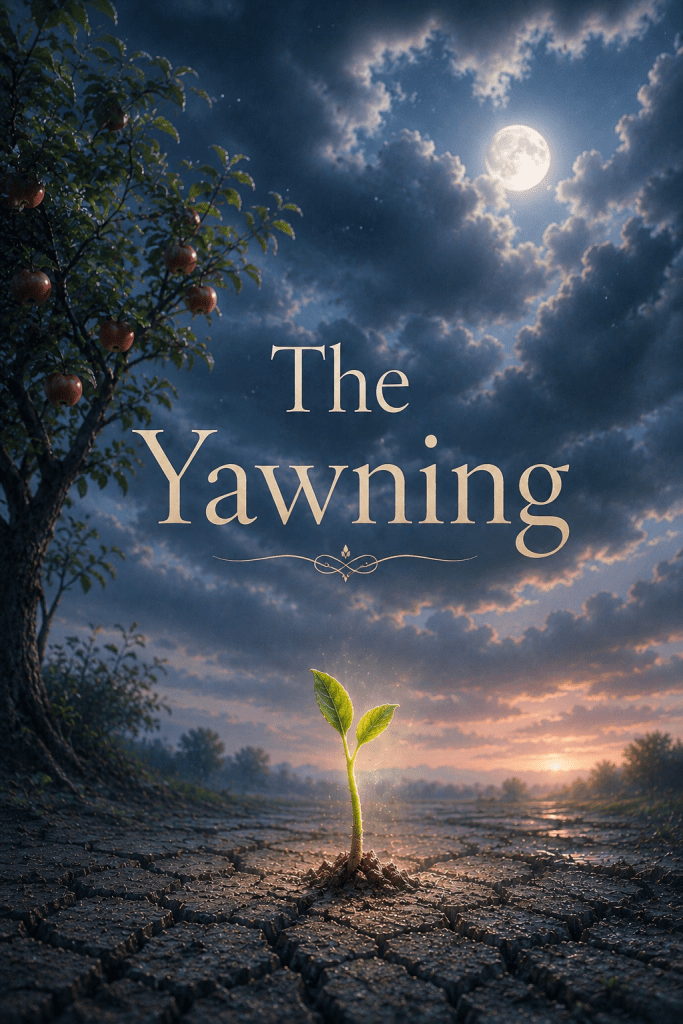
  • The Yawning


    A clap of thunder filled the earth,
    the heavens wept, the mockingbird.


    A flash of lightning filled the sky,
    and crickets sang their lullaby.
     
    The night wind crept on little feet
    and whistled past the apple tree.
    The moon hid behind a cloud still,
    trying slyly to peek out.
     
    The dry, cracked earth drank heaven’s tears
    like a withered face consumed with years.


    Then the yawning little sprout
    stretched wide its arms and wandered out.
     
    Rising up to touch the stars,
    its tender limbs rose through the scars.
     
    What thirst had withered, grace restored.
    So every wound becomes a door.

  • Be Still My Soul

    Be Still My Soul
     
    Be still, my soul.
    Soul, be still.
    Be still, O soul.
    Soul, be healed.
     
    How can I be healed
    when my languishing cries
    call out through pouring eyes?
     
    Be still, my soul.
    O soul, please still.
     
    So I may finally rest
    awhile here.
     

  • The Bruising of Beautiful Things

    The Bruising of Beautiful Things
     
    Human suffering is vast, layered, inherited, and ancient.
    It stretches across generations, cultures, bloodlines, and history.
    Pain did not start with us, and it does not end neatly.
     
    Even the things that begin pure —
    love, family, faith, power, desire —
    pass through broken hands in a fallen world
    and so often come out distorted.
     
    This is not cynicism.
    It is grief with its eyes open.
     
    There is a particular weight that comes
    when someone truly sees this —
    not only intellectually,
    but spiritually and emotionally.
     
    It is the realization that:
     
    innocence is fragile
    goodness is vulnerable
    nothing escapes corruption untouched
     
    And that awareness can be crushing.
     
    But seeing the depth of suffering
    does not mean meaning is lost.
    It means the cost of love is high.
     
    In a fallen world,
    purity is not preserved by being untouched —
    it is preserved by enduring
    without becoming what harmed it.
     
    That is rare.
    And costly.
    And often lonely.
     
    Hardened hearts do not grieve corruption.
    Only hearts that still value goodness
    ache this deeply over what has been wounded.
     
    There is a difference between:
     
    “Everything is ruined, so nothing matters.”
     
    and
     
    “Everything has been wounded,
    and that matters immensely.”
     
    Grief often disguises itself as shame.
     
    Many people who value faith, peace, self-control, and integrity
    end up judging their own need for love
    because it feels disruptive, vulnerable, or unsafe.
     
    Especially when love has not been reliably available,
    the longing itself can begin to feel like an enemy.
     
    But needing love is not weakness.
    It is part of being human.
     
    Some people age forward
    but never arrive.
    Others arrive later —
    but arrive whole.
     
    What was gained in those “extra” years
    was not delay.
    It was depth.

  • Because You Are Loved

    Because You Are Loved
     
    If faith is irrational, why do so many rational minds believe?
    And if faith is rational, why do so many intelligent minds reject it?
     
     
    Very wise men and women believe in Jesus Christ.
    Very wise men and women dismiss Him.
     
     
    This has always troubled me.
     
     
    If faith is irrational, why do so many brilliant minds embrace it?
    And if faith is rational, why do so many equally intelligent people reject it?
     
     
    The older I get, the more I realize this is not an IQ question.
    It is a trust question.


    Reason can take us far.
     
     
    Reason can tell us that the universe had a beginning,
    that moral law exists,
    that beauty and meaning are real,
    and that suffering demands an explanation.
     
     
    But reason alone cannot answer the question that matters most to a suffering human being:
     
     
    When my strength fails,
    when my body weakens,
    when my world grows smaller…
    will I be held?


    This is where faith begins.
     
     
    Not where thinking ends,
    but where relationship begins.


    Scripture itself invites reason, not blind belief.
     
     
    “Come now, and let us reason together, saith the Lord.”
    — Isaiah 1:18
     
     
    And again:
     
     
    “Always be ready to give a reason for the hope that is in you.”
    — 1 Peter 3:15


    Christian faith has never asked us to abandon the mind.
    It asks us to recognize the limits of the mind.


    I am not afraid of death.
     
     
    I am afraid of decline without love,
    of dependence without dignity,
    of being unseen when I am most vulnerable.


    And this is where my faith has been quietly reshaped.
     
     
    Christianity does not promise that the future will be easy.
    It promises something more sober and more profound:
     
     
    “I will never leave thee, nor forsake thee.”
    — Hebrews 13:5


    Not, “I will fix everything.”
    But, “I will be with you.”


    The question faith answers is not,
    Can I understand the future?
     
     
    It is this:
     
     
    When I can no longer carry myself,
    will I still be carried?


    And Scripture answers this with startling tenderness:
     
     
    “Even to your old age and gray hairs I am He;
    I am He who will sustain you.
    I have made you, and I will carry you;
    I will sustain you and I will rescue you.”
    — Isaiah 46:4


    Faith is not pretending we will remain strong.
    Faith is trusting that when we are no longer strong,
    we will not be abandoned.


    There is a verse that has become very precious to me:
     
     
    “Cast all your care upon Him; for He careth for you.”
    — 1 Peter 5:7


    Not because all care disappears,
    but because someone else carries it with me.


    So perhaps faith is rational in this sense:
     
     
    not because it explains everything,
    but because it answers the only question the future finally asks of us:
     
     
    When I am no longer strong,
    will I still be safe?


    And Christianity dares to answer:
     
     
    “Yes.
    Not because you are strong.
    But because you are loved.”


    “The Lord is my shepherd; I shall not want…
    Yea, though I walk through the valley of the shadow of death,
    I will fear no evil: for Thou art with me.”
    — Psalm 23:1, 4


    Perhaps faith is rational not because it explains everything,
    but because it teaches us whom to trust when understanding ends.

  • Dreamers

    The feverish passion of fervent dreams,
    dreams that will not die.


    Though the storms of life threaten them,
    there they stand in solid sight.


    Still there after all the hell,
    dreams ring their little bells,
    as if to yell,
    “I’m still alive…”
    not waiting for the soul
    to quell.


    Sailing past the jagged shore,
    dreams press ever at my door.
    On the wind a song must be,
    the dreamer’s imagination beckons me.


    So I take my pen,
    my hammer forged,
    and I begin to build as unto the Lord.
    To reach as far from earth to sky,
    for dreamers still dreaming
    and passersby.

  • Bind Truth About Thy Neck


    There is a difference between studying truth and binding yourself to it.
    Information can sit in the mind for years without ever reaching the heart. It can be quoted, debated, translated, examined, and still remain distant from the soul. But Scripture speaks of truth differently. It speaks of truth as something to be carried close.


    “Let not mercy and truth forsake thee: bind them about thy neck; write them upon the table of thine heart.” — Proverbs 3:3
    To bind truth about your neck is to live near it. To write it upon the heart is to let it shape the inner man.


    Truth in Scripture was never presented as merely intellectual possession. It was meant to become part of a person’s discernment, conscience, conduct, worship, and understanding of God Himself.


    This is why spiritual instability often begins long before visible compromise appears. A person does not drift merely because they encountered difficult questions. Questions alone are not dangerous. Scripture itself contains deep mysteries, difficult passages, and truths that require humility and maturity to understand.


    The danger begins when reverence weakens.
    There is a kind of study that draws a person deeper into awe, dependence, humility, and worship. It illuminates meaning without changing the foundation. It deepens understanding while preserving the fear of the Lord.
    But there is another kind of approach that slowly places human reasoning above the authority of God’s word. Instead of seeking illumination, it begins seeking permission to reinterpret the foundation itself.


    One posture says: “Lord, teach me your truth.”
    The other quietly says: “Lord, I will decide what can still be called truth.”
    The difference between the two may appear subtle at first, but over time the fruit becomes visible.
    The deeper meanings found within Hebrew and Greek studies, biblical patterns, prophetic symbolism, and scriptural harmony were never meant to dismantle confidence in Scripture. They were meant to magnify the depth already present within it.

    True illumination does not replace truth. It reveals its richness.
    A child may read: “The Lord is my shepherd,” and find comfort.
    A mature believer may read the same verse decades later and discover layers of dependence, correction, covenant, kingship, sacrifice, and the nature of Christ Himself.


    The verse did not evolve. The understanding deepened.
    Truth remains truth.
    And perhaps that is why Scripture repeatedly calls believers not merely to hear truth, but to hold it close.
    “Buy the truth, and sell it not…” — Proverbs 23:23
    Not because truth is fragile, but because the human heart is.


    In every generation there will be voices that question foundations, reinterpret authority, or reshape what previous generations held sacred. Some questions arise from sincere wrestling. Others arise from pride disguised as enlightenment. Discernment is needed to know the difference.


    But the answer to confusion is not panic. It is nearness to God.


    The believer does not remain grounded by intellectual mastery alone, but by abiding in Christ, remaining in prayer, walking humbly, and allowing the Holy Spirit to continually illuminate the word of God.


    Truth was never meant to be worn loosely.
    It was meant to be bound about the neck and written upon the heart.

  • Emotional Triggers

    When Old Wounds Still Echo
     
    Some memories do not live in words.
    They live in reactions.
    A scent. A sound. A scene in a movie. A trigger that awakens something buried deep within the nervous system.
    And suddenly the body remembers what the mind was not trying to revisit.
    The heart races. The stomach tightens. Anxiety rises without invitation. Images return unannounced.
     
    Often, people assume this means they have failed to heal. That forgiveness was not real. That faith was not strong enough. That time should have erased the reaction by now.
    But healing is not always the absence of memory. Sometimes healing is learning how to remain present when memory echoes.
     
    There are wounds that do not stay in the conscious mind as daily thoughts. They settle quietly beneath the surface until something unexpectedly triggers them. The reaction can feel confusing, especially when years — even decades — have passed.
    This is particularly true when the memory involved helplessness, fear, betrayal, or violence. The soul may have moved forward while the body still remembers the alarm.
     
    Scripture acknowledges that human beings are not merely minds floating through existence. We are spirit, soul, and body. What affects one often touches the others.
    David wrote:
    “When my heart is overwhelmed: lead me to the rock that is higher than I.” — Psalm 61:2
    Notice he did not deny the overwhelm. He acknowledged it. Then he sought refuge above it.
     
    There is an important difference between being haunted by bitterness and being startled by unresolved pain.
    A person may truly forgive and still experience moments where old grief reverberates through the body. Forgiveness does not always erase every emotional imprint immediately. Sometimes forgiveness is a decision made in the spirit while healing unfolds slowly over time.
     
    The modern world often pressures people toward one of two extremes: pretend nothing affected you, or become permanently identified by what hurt you.
    Neither is healthy.
    There is a quieter path: to acknowledge the wound honestly without allowing it to become your identity.
     
    Healing is not always dramatic.
    Sometimes it looks like learning to breathe through the trigger instead of collapsing beneath it. Sometimes it looks like grounding yourself in the present moment rather than drowning in the past. Sometimes it looks like recognizing: this memory is echoing… but it is not happening again.
     
    The Lord does not ask us to become emotionless in order to be healed. He meets us truthfully.
    Christ Himself carried scars after resurrection. Glorified — yet marked.
    That alone tells us something profound:
    A healed wound and a remembered wound are not always the same thing.
     
    And yet, there is hope.
    The echoes do not have to control the entire atmosphere of your life. The trigger does not have to define your future. The memory does not have to own your peace forever.
    Little by little, the nervous system can learn safety again. Little by little, the soul can loosen its grip on fear. Little by little, the body can stop preparing for battles that are no longer taking place.
     
    Healing is often quieter than we imagined.
    Not the erasing of history.
    But the steady reclaiming of peace.

  • Fire Furnishes


    On Suffering, Sonship, and Unearthing Freedom
     
    Some children learn to shine. Some children learn to survive. I learned to become someone who quietly disappears. Not loudly. Not dramatically. Quietly. It felt safer to shrink than to need, safer to endure than to ask, safer to disappear than to risk being too much.
     
    When your earliest mirror teaches you to brace instead of behold, suffering feels familiar. It feels strong. It feels noble. So when I later believed that obedience is sacrifice, sacrifice is suffering, obedience is proof of love, and proof of love is suffering, it did not feel distorted—it felt devoted.
     
    But Scripture says in Romans 12:1 to present our bodies a living sacrifice. Living. Obedience is alignment. Sacrifice is surrender. Suffering is sometimes a byproduct of a broken world. They overlap—but they are not synonyms. That distinction is small, but it changes everything.
     
    If obedience is alignment, then it is about agreement, not injury. If sacrifice is surrender, then it is about yielding, not disappearing. If suffering is sometimes a byproduct of a broken world, then it is not the currency of love. And if I have been living through the mirror of a slave, then of course suffering feels sacred. It feels like currency. It feels like devotion made visible. Feeling sacred does not mean it is true, healthy, or sacred.
     
    The fire is doing something deeper. It is burning away the lie that disappearing is holy, that suffering is delighted in by the Lord. It is exposing the difference between living life through a healthy mirror of sonship and the distorted mirror of a slave. Because Romans 8:15 says we did not receive the spirit of bondage again to fear, but the Spirit of adoption.
     
    A slave proves. A son rests. A slave fears losing favor. A son abides in love. A slave endures to earn. A son obeys because he belongs. If I have been living through the mirror of a slave, then of course suffering feels sacred. It feels like devotion made visible.
     
    But a living sacrifice is still living. And Jesus said in John 10:10 that He came that we might have life—and have it more abundantly. Goodness is not betrayal. Flourishing is not worldliness. Peace is not pride.
     
    Fire furnishes. It furnishes a clearer mirror. It furnishes identity without diminishing self-care and abundant life. It furnishes sonship that does not depend on suffering. Fire furnishes. It furnishes a clearer, healthier mind and mirror image. It furnishes identity without erasing self-care and abundant life. It furnishes sonship that does not depend on suffering, but on trusting.
     
    But I cannot undo years of psychological grooming caused by trauma in my tiny, innocent life beginning at the age of five. I cannot undo the trauma it has caused me in one afternoon with you and the Lord. I am on a journey. I have to examine everything that has made me believe lies about myself. I want to be whole. This is just the beginning of unearthing freedom from the accusing mirror.
     
    Fire furnishes. Not instant healing. Not overnight clarity. But the courage to look honestly. The grace to untangle what once felt noble. The patience to heal in layers. A living sacrifice is still living. And I am learning to live.
     
    Obedience is alignment. In Scripture, obedience means to hear and respond in agreement with God (John 14:15; Romans 6:16). It is relational alignment, not self-destruction. Sacrifice is surrender. Romans 12:1 calls us a living sacrifice. The shift from dead offerings to living devotion is crucial—sacrifice in the New Covenant is yielded will, not bodily harm. Suffering is sometimes a byproduct of a broken world. Jesus says in John 16:33 that in this world we will have trouble—not because God delights in pain, but because the world is fallen.
     
    Suffering is not the currency of love. Christ’s suffering purchased salvation once for all (Hebrews 10:10). We do not add to it. Our suffering does not validate our love for God. Love is expressed through obedience, not pain accumulation (John 14:15). Sonship and slavery are not the same. Romans 8:15 explicitly contrasts bondage and adoption—fear-based performance is the posture of slavery, while restful belonging is the posture of sonship.
     
    God delights in abundant life. John 10:10 speaks of fullness, vitality, and flourishing in Christ. God is good (Psalm 23:6). He is not sadistic. The Bible does not deny that suffering can refine us (James 1:2–4; 1 Peter 1:6–7), but refinement is different from requirement. God may use suffering, but He does not worship it. He does not need it to feel loved. He does not delight in your diminishment.
     
    I am not abandoning the cross. I am reevaluating the mindset that gives validation to a distorted mirror by embracing suffering as an acceptable offering to prove loyalty to Him. There is a massive difference. The cross is Christ’s finished work. My life is the fruit of it—not a reenactment of it.
     
    I am not becoming shallow. I am becoming aligned. God’s goodness does not cancel suffering. Suffering does not increase God’s love. Sonship does not require self-punishment. Maybe the real sacrifice we can make is learning to live in this view of love.

  • The White Dawn


    The King of Kings will break the sky,
    on white steed He’ll descend;
    With Him the Bride of Christ, blood-sealed,
    the ransomed born again.


    No whispered trumpet veiled in cloud,
    no secret flight above—
    but heaven split by righteous fire
    and blazing covenant love.
    The nations gathered in their might,
    with iron, pride, and flame,
    will find their banners fall like dust
    before His holy Name.


    Jerusalem will lift her eyes
    through smoke and battle cry,
    And see the once pierced now before her,
    robed in majestic light.
    Not Lamb led silent to the grave,
    not mocked, nor crowned with thorn—
    but Lion crowned with many crowns,
    the Father’s only begotten, Born.


    The Mount will tremble at His step,
    the valleys cleave in two;
    creation bends beneath the weight
    of promises long true.
    We do not come with earned renown,
    nor trophies from a war,
    but clothed in white His mercy wove
    before the world was formed.


    No battle stretched through weary hours,
    no clash of equal might—
    the brightness of His coming breaks
    the arrogance of night.
    Then He sets His feet upon the earth,
    time surrenders to His reign;
    and every knee will bow beneath
    the mention of His name.

  • The Speck & The Savior


    Stand still for a moment and consider the scale of things. 

     We live on a planet that feels vast beneath our feet—oceans stretching beyond sight, mountains rising into clouds, cities alive with movement and sound. Yet this same Earth, so immense to us, becomes a mere speck when placed beside the sun. And the sun, blazing and enormous, is only one among billions within a single galaxy. That galaxy, in turn, is only one among countless others scattered across a universe so wide that numbers begin to lose their meaning. 

     Layer upon layer, scale upon scale, everything expands until the human mind reaches its limit. 

     “And when I consider thy heavens, the work of thy fingers, the moon and the stars, which thou hast ordained; What is man, that thou art mindful of him? and the son of man, that thou visitest him?” (Psalm 8:3–4) 

     And somewhere within all of that— You are here. 

     A single life. A single breath. A single beating heart on a small planet circling one ordinary star. 

     By every measurable standard, we are small. Not just small—almost invisible. 

     “All flesh is grass, and all the goodliness thereof is as the flower of the field.” (Isaiah 40:6) 

     It would be easy to conclude that we are insignificant, that our lives are swallowed up by the vastness surrounding us. 

     But the story does not end there. 

     Because while the universe expands outward in incomprehensible scale, something else moves inward—toward us. 

     “The Word was made flesh, and dwelt among us…” (John 1:14) 

     The same God who set galaxies into motion did not remain distant from what He created. He did not speak the universe into existence and then withdraw into its farthest reaches. Instead, He stepped into the very smallness we struggle to understand. 

     He entered our world. He took on flesh. He lived within the limits of time, space, and human experience. 

     Not as a distant observer, but as one of us. 

     “Who, being in the form of God… made himself of no reputation, and took upon him the form of a servant, and was made in the likeness of men.” (Philippians 2:6–7) 

     The Creator of immeasurable vastness chose nearness. 

     And even that was not the end of it. 

     Because the story goes further still—beyond visitation, beyond a moment in history. 

     He did not only come to us. He chose to dwell within us. 

     “Know ye not that ye are the temple of God, and that the Spirit of God dwelleth in you?” (1 Corinthians 3:16) 

     “Christ in you, the hope of glory.” (Colossians 1:27) 

     The same God who holds the universe together does not merely stand above it—He makes His home within the human heart. 

     This is the mystery that redefines everything: 

     We are small beyond comprehension, yet we are not overlooked. 

     “Are not two sparrows sold for a farthing? and one of them shall not fall on the ground without your Father… Fear ye not therefore, ye are of more value than many sparrows.” (Matthew 10:29,31) 

     We are finite, yet we are inhabited by the presence of the infinite. 

     “God that made the world and all things therein… dwelleth not in temples made with hands… For in him we live, and move, and have our being.” (Acts 17:24,28) 

     We are dust, and yet we carry glory. 

     “But we have this treasure in earthen vessels, that the excellency of the power may be of God, and not of us.” (2 Corinthians 4:7) 

     So when you look out at the night sky and feel the weight of its vastness, let it humble you—but do not let it diminish you. 

     Because the same truth that reveals your smallness also reveals your worth: 

     Out of all that exists, He came here. 

     “For God so loved the world, that he gave his only begotten Son…” (John 3:16) 

     And not only here— 

     He came to you. He chose to live in you. 

     And suddenly, the smallest place in the universe becomes the most sacred. 

  • The Quiet Place

    The Quiet Place Where God Speaks
    There is a place where noise cannot follow.
    It is not found by searching harder, but by surrendering deeper.
     
    I have learned that God does not compete with my voice.
    He does not interrupt my thoughts or force His way in.
    He waits—quiet, steady, unmoved—until I am willing to become still.
     
    And stillness is not easy.
    My mind runs.
    My heart wrestles.
    My will rises with its own desires, its own fears, its own need to understand.
     
    But His voice is different.
    It comes like a whisper carried on peace—
    not demanding, not loud, but certain.
     
    “Be still, and know that I am God.” — Psalm 46:10
     
    To hear Him, I must release the need to control the moment.
    I must loosen my grip on my own understanding
    and allow His presence to settle over me like morning light.
     
    There, in that quiet place, I begin to recognize Him again—
    not distant, not silent, but near… and always speaking.
     
    And I realize—
    He was never absent.
    I was just too full to hear Him.
     
    Key Points:
    • God does not compete with your voice—He waits for stillness
    • His voice is quiet, not forceful, but certain
    • Stillness requires surrender, not effort
    • You don’t find Him by striving, but by yielding
    • He is always speaking—you are learning to hear

  • The Speck & The Savior – Beneath the Starry Skies.


    The Speck & The Savior Beneath the Starry Skies
     
     
    A speck beneath a sky so wide,
    Where silent stars like lanterns hide,
    I lift my eyes, feel small and still,
    Yet something draws my heart to fill.
     
    Not lost within the endless blue,
    But gently known, completely through,
    For He who shaped the distant flame
    Has softly called me by my name.
     
    He stepped into this dust I wear,
    Breathed life and met me right there,
    Not far above, nor just to see—
    But chose to come and dwell in me.
     
    So let the heavens stretch and shine,
    Their vastness does not dim what’s mine—
    For though I’m small, this truth I savor,
    This tiny speck is held by the only Savior.
     

  • Just a Little While

    In just a little while,
    and the storm begins to ease,
    what once felt like a breaking
    softens into breath and peace.
     
    In just a little while the thoughts that flay wildly,
    Like leaves in stirring air will fall into peaceful idly.
     
    In just a little in the dark of absent sun,
    The night will flee, and I will see that I was not undone.
     
    In just a little while…
    and the weight begins to move,
    not by strength I carried,
    but by mercy I can’t prove.
     
    In just a little while the looking glass will clear,
    No longer lies and cruelty will ever reach my ear.
     
    In just a little while the rest I deeply long,
    I will be in his house forever—not by my own power, but by the blood of Christ alone.

  • Steadying the Helm – A Poet’s Prose.

    Steadying the Helm
    Nothing has broken,
    yet something has moved,
    no waves are rising,
    no peace disproved.

    The waters are quiet,
    the sky holds its light,
    no storm in the distance,
    no need for a fight.
    Yet deep in the stillness,
    I feel the slight sway,
    a shift in the current
    I cannot delay.

    Where once I moved freely,
    unthinking, at ease,
    I now move with care
    like a hand on the seas.
    No panic within me,
    no tightening hold,
    just quiet intention,
    steady and controlled.

    No need to chase voices
    to prove I remain,
    no turning to coldness
    in silence or pain.

    So here at the helm,
    I choose to stand true,
    not lost in the movement,
    not changed by the view.
     
    For even in shifting,
    one thing overwhelms—
    To not lose myself
    while steadying the helm.

  • Navigating the Storm

    Do you ever feel like your relevance is slipping?

    There are moments when you begin to feel it—The shift.
    The space where your voice once carried weight feels quieter.
    The places you once fit seem to move without you. It can come at many different times. Prolonged illness, moving away from familiar friends and family into a new city or town? These seasons in our lives shift us in ways that sometimes make us unsteady in our sense of belonging and relevance.
    And a question forms, not out loud, but deep within:
    Is my time of being relevant over?

    It’s an unsettling place to stand.
    Because relevance, in our minds, feels tied to being seen, being needed, being valued.
    And when those things feel uncertain, it can shake more than just confidence—
    It can begin to touch your heart.
    But relevance is not as fragile as it feels.
    It does not expire like a season that ends without warning.

    It shifts.
    It moves.
    It redirects.
    What once required your voice may no longer be where you are meant to pour it.
    And what once felt natural may now feel resisted.
    That is not rejection.
    That is transition.
    The danger is not in losing relevance.
    The danger is in what can happen to your heart while you’re trying to hold onto it.

    You can become sharper.
    Quieter in the wrong ways.
    Withdrawn, not from wisdom—but from hurt.
    You can begin to measure your worth by response.

    By recognition.
    By whether or not you are still being reached for.
    And slowly, without meaning to, love can start to thin.
    This is where the question must change.
    Not: “Am I still relevant?”
    But: “Am I still loving?”
    Because relevance without love becomes performance.
    And loss of relevance, if handled wrongly, can become bitterness.

    There is a way to move through this without losing yourself.
    You are still loving if you do not desire harm, even when overlooked.
    You are still loving if you refuse to become cold in response to distance.

    You are still loving if you can step back without turning inward in resentment.
    You are still loving if you remain honest without becoming harsh.
    Love does not demand to be seen to remain true.
    And here is the steadying question:
    Am I trying to remain true… or am I reacting to being unseen?
    That question will reveal everything.
    Because sometimes what feels like loss of relevance
    is simply the end of a place that no longer fits who you are becoming.

    There will be moments where you feel like you are standing still while everything else moves.
    But stillness is not the same as being finished.
    Sometimes it is where realignment happens.
    Where your voice is refined.
    Where your heart is tested—not to break it, but to prove it.
    Relevance is not your identity.
    It is a byproduct of alignment.
    And when you are aligned—truly aligned—
    you do not have to chase being seen.
    You will be effective where you are placed.
    So if you find yourself asking whether your time has passed,
    Pause.
    Not in fear,
    but in honesty.
    Check your heart.
    Guard your love.
    And allow the shift to do its work.
    Because your time is not over—
    It may simply be moving
    to a place where what is in you
    is received again.

  • The Posture of Trust

    There are moments in life when strength fades quietly.
    Not all at once.
    Not dramatically.
    Just enough that you feel it slipping—
    your footing unsure,
    your thoughts too heavy,
    your heart overwhelmed by things you cannot control.
     
    In those moments, I do not stand tall in confidence.
    I do not speak bold declarations.
    I do not have answers that quiet the storm.
    I become small.
     
    Like a child who has lost their way,
    I run to Him—tearful, sobbing in desperation.
    I grab hold of His legs,
    bury my face in His garment,
    and I hold on tight.
     
    There are times when I feel like I’m losing my grip,
    my strength fails me.
    But He is faithful and steady.
     
    Because sometimes trust does not look like peace—
    it looks like refusal to let go.
     
    No polished prayers.
    No rehearsed faith.
    Just clinging.
     
    I do not understand the timing of life.
    I do not know when things will end
    or how everything will unfold.
    But I know this:
     
    The One I am holding onto
    is certain.
    The One I cling to
    is not shaken by what shakes me.
     
    And so I stay there—
    wrapped around Him,
    grounded not by answers,
    but by His presence.
     
    There is a quiet safety in that place.
    Not because everything around me is resolved,
    but because I am no longer trying to hold everything together.
    I am being held.
     
    So how do I know if I trust Him?
    Not by how strong I feel.
    Not by how calm my thoughts are.
    But by this:
     
    When everything in me wants to run,
    do I still reach for Him?
    When I don’t understand,
    do I still stay?
    When fear speaks loudly,
    do I still hold on?
     
    If my answer is yes—
    even weakly,
    even desperately—
     
    Then I am trusting Him.

  • The Early Morning

    His voice is still and small, not pressing on my will,
    He waits for me to bend, to break open the seal.
     
    He speaks in whispers quiet in the breeze as passers by it,
    Quiet as a mouse, He moves about the house,
    Waiting for me to come to Him in the morning hours.
     
    Getting ready for the day, I begin to pray,
    Unaware He’s not getting in the way.
     
    My tears fall like summer showers,
    And just then a blossom flowers.
     
    I see Him then and gently nestle closer in,
    I hush my soul as His voice becomes my only hymn.
     
    There we are, just me and Him.

  • No Peace in Sin

    There is a difference between a failing believer and a person who remains in sin—and it is not found in perfection.

    It is found in the posture of the heart.
    Both may sin. Both may fall. But they do not stand in the same place when they do.

    A truly born again believer cannot make peace with sin. They may stumble into it, but they cannot settle in it. Something within them resists—grieves—refuses to make peace with it.

    Romans 6:14 tells us that sin no longer has dominion. That means it no longer rules, no longer governs, no longer sits on the throne. Its presence may remain, but its authority is broken.

    So when a believer sins, something rises up within them that was not there before—conviction, discomfort, a pulling back.
    John 16:8 says the Spirit convicts—not to condemn, but to draw back, to realign, to restore.

    This is where the line is drawn.
    A failing believer falls, but returns. They feel the weight and cannot rest under it. They do not justify what God has already called sin.
    But a heart unchanged can learn to live with sin. It can explain it away. It can grow quiet under it. It can remain.
    1 John 3:9 speaks of this—not a life of sinless perfection, but a life that cannot continue in sin as a settled pattern. Not because of effort alone, but because something has been planted within that opposes it.
    And there is a danger that must be understood clearly.

    When conviction is continually resisted, it does not disappear—but the heart grows quieter toward it.
    Ephesians 4:30 warns us not to grieve the Spirit. 1 Thessalonians 5:19 tells us not to quench Him. 1 Timothy 4:2 describes a conscience that can become seared.

    Not because He stops speaking—but because the unregenerates heart begin to prefer another voice.

    The voice of the Spirit does not fade—our sensitivity to it does.
    And when the flesh is given priority again and again, conviction becomes easier to ignore—not because it is absent, but because it is no longer being answered.

    This is the difference.

    It is not the absence of sin, but the absence of peace in it.

    There are those whose lives  reflect a willingness to stand for what they believe, even when it costs them something. Charlie Kirk appears to be one of those individuals—open about his faith, unashamed to speak it publicly, and consistent in his message. While only God truly knows the heart (1 Samuel 16:7), there is something to be said for a life that does not shrink back—not as a measure of perfection, but as a visible expression of conviction lived out.

    And this is where the born again spirit must speak clearly.
    I do not want to be a slave—to anyone or anything—especially not to my own flesh.
    Romans 6:16 reminds us that we will serve what we yield ourselves to. But Romans 6:22 declares the greater truth—we have been set free from sin and have become servants of God.

    So this is no longer about striving to become free—it is about refusing to return to what once ruled.
    It is the desire of my heart to live a life that honors God. Anything less is not small to me… it is not casual… it is not easily dismissed.

    It is costly.
    Because I was not set free to go back—I was set free to live.
    So the question is not simply, “Do you sin?”
    But—
    Do you return?
    Do you resist settling?
    Do you remain sensitive when God speaks?
    Because peace with sin is the real danger.
    But the struggle against it—the refusal to call it home—is evidence of life.

    And so, I press on.

  • Forever Finished


    Sin stands lingering in the doorway of basic human moments trying to control the soul. While failure comes quietly—
    not loud,
    not announced—
    just a whisper.
     
    Bringing accusation, fear and guilt.
    What now?
     
    As if a single fall
    could reach backward
    and undo what heaven sealed.
     
    As if a misstep
    could rename
    what God has already redeemed.
     
    But the cross—
    it does not hesitate.
    it does not withdraw.
     
    It stands,
    unmoved,
    where mercy and judgment met
    and something final
    was spoken.
     
    So when our step slips,
    and the weight of it settles
    deep in the chest,
    the work beneath it
    does not shift.
     
    There is a difference—
    quiet, but absolute—
    between the one who wanders
    and still turns at the sound of His name,
    and the one who leaves
    and grows silent.
     
    Where there is turning,
    there is tether.
     
    Not held by strength,
    not proven by perfection,
    but by something deeper—
    a pull that does not break.
     
    Human weakness does not decide the end.
    It only reveals
    what was never held
    by human hands—
     
    but by the covenant of His blood,
    where love did not measure,
    did not hold back,
    but gave fully,
    once—
     
    and called my redemption finished.

  • After The Fall

    There is a question that quietly unsettles many hearts:
    What happens after failure? After knowing truth, after receiving grace—what happens when sin shows up again?
     
    Does one misstep undo everything?
    Does falling mean becoming what was once left behind?
     
    The weight of that question often comes from a misunderstanding of what truly changed in the moment of new birth.
     
    To be born again is not the beginning of behavior modification. It is the transformation of identity. What was once defined by sin is no longer the governing nature. Scripture speaks clearly: “If anyone is in Christ, he is a new creation; old things have passed away; behold, all things have become new” (2 Corinthians 5:17). This is not symbolic language. It is positional truth.
     
    Righteousness is not earned through consistency, nor is it revoked by failure. It is given through Christ. “He made Him who knew no sin to be sin for us, that we might become the righteousness of God in Him” (2 Corinthians 5:21). That righteousness is not fragile. It does not dissolve under pressure.
     
    Yet there remains a passage that causes many to tremble: “If we sin willfully after receiving the knowledge of the truth, there no longer remains a sacrifice for sins” (Hebrews 10:26).
     
    This is not a warning to the struggling believer. It is not directed at the one who falls and grieves it. It speaks of something far more severe—the rejection of the only sacrifice that exists. There is no other offering beyond Christ. To turn away from Him entirely is to stand outside of the only provision ever made for sin.
     
    But this is not the posture of a heart that still turns back, still feels the weight, still desires restoration.
     
    When a believer sins, something is disrupted—but it is not sonship. It is not identity. It is fellowship.
     
    The relationship remains intact, but closeness can be strained. Peace can be interrupted. The awareness of God’s nearness can feel distant. Yet even here, provision has already been made.
     
    “If we confess our sins, He is faithful and just to forgive us our sins and to cleanse us from all unrighteousness” (1 John 1:9).
     
    There is no call to be reborn again and again. There is no reinstatement process. There is confession, and there is cleansing.
     
    This is the difference between falling and departing.
     
    One stumbles and turns back.
    The other walks away and does not return.
     
    These are not the same.
     
    The foundation of salvation does not rest on human consistency but on a finished work. “It is finished” (John 19:30) was not a partial statement. It was not conditional. It was complete.
     
    If sin could undo what Christ accomplished, then the cross would not have been sufficient. But it was.
     
    Failure does not redefine identity. It reveals the need to return to alignment with what is already true.
     
    The one who belongs to Him is not cast out by weakness. The door remains open—not because sin is light, but because grace is greater.
     
    And what was secured by Christ is not so easily undone.

  • The Quiet Green

    The Quiet Green
    The world was smaller then,
    and lighter—
    my youth making me oblivious
    to pressure.
     
    Barefoot again,
    and translated back
    to when I was younger.
     
    Moments unfolding before me,
    and I without a clue
    what a treasure those times were.
     
    Soaking it in now
    as if my soul was starving
    to find this feeling once more.
     
    The grass is softer here,
    or maybe I’ve forgotten
    how to feel it.
     
    It slips between my toes
    like it used to—
    cool, forgiving,
    familiar in a way nothing else is.
     
    Smells of honeysuckle in the air,
    with hints of dew, blankets of morning glorys fill the garden, the innocence of it all so profound now.
     
    Clinging gently to each step
    like the day has just begun for me.
     
    I don’t rush across it.
    I wander.
     
    Step, pause… step again,
    like there is nowhere I need to be.
     
    I press my feet down deeper,
    as if I might step back into it—
    those days.
     
    These moments are to be remembered.
     
    I take a slow walk through my mind,
    bringing these little treasures
    with me.
     
    Then I open my eyes,
    and take comfort
    in the deep sigh
    of such beautiful recollection.
     
    For this,
    I am thankful.

  • The Other Heart

    Sometimes my mind reverts back time and time again—to hard places in my life where life didn’t turn out like I had planned or even worked for. I try desperately to get it all to make sense, but doesn’t.

    “If love was real… if it was given… if it was lived… how did it not come back to me the same way?”
    It can feel like reality itself has fractured. Like something that should add up simply refuses to.

    But love is not a logical by system.
    It does not always align with goodness, effort, faithfulness, or even shared history. If it did, love would be predictable. It would reward what is given with equal return. And yet, it does not.

    What often happens in that space of confusion is this: the heart tries to use its own language to interpret someone else’s capacity.
    But those are not the same.

    One heart may attach deeply, stay steadily, invest fully, and feel intensely. Another may not be built to hold or return love in that same way. Not better. Not worse. But different in capacity, wiring, and limits.

    So the mind protests—this doesn’t make sense.
    And it’s right, in a way. It doesn’t make sense from a heart that loves deeply and consistently.
    But it begins to make a different kind of sense when considering that not all people sustain emotional closeness the same way. Some do not attach as deeply.

    Some close off after being hurt and never fully reopen. Some simply cannot meet the depth that is being offered to them.
    And here lies one of the hardest truths to accept:
    A person can be fully lovable… and still not be loved by a specific person.

    Not because love itself failed, but because the other person could not meet it where it stood.
    The pain that follows often comes from the mind trying to resolve what feels unresolved—to rewrite the story, to find a reason, to make the ending fair.

    But not every ending offers an explanation that satisfies the heart.
    And so the work is not always in understanding the other person.
    Sometimes, the work is in standing still long enough to hold onto one steady truth:
    “I may not understand what happened… but that does not mean I deserved it.”

    There are moments in life where love does not return in kind.
    And that is not something to solve in a single sleepless night.
    It is simply something to stand in, to feel, and—slowly—to learn how to carry without letting it define what was always true:
    Your ability to be loved was never the problem. The other persons capacity to love you was limited, and their heart did not hold love in the way yours did.

    The absence of returned love does not define worth; it reveals a limit in the other person’s capacity to love in that way.

    What was given was real, and it remains valid even when it is not received in kind.

    One of the greatest challenges in life is loving fully and resisting hardness and bitterness

    Do not use your loving and beautiful heart’s logic
    to try to understand anothers heart’s capacity.

    Instead, learn how to make better choices, be kinder to yourself and school yourself on what it truly means to be equally yoked.

  • What Have You Done With My Lord

    Mary’s cry in Gospel of John 20:13 — “They have taken away my Lord, and I do not know where they have laid Him” — wasn’t just grief… it was love looking for presence. She wasn’t analyzing doctrine.

    She was aching for Him.
    Mary’s heart broke when she saw the angels at Jesus’ tomb. She cried,
    “What have you done with my Lord?”
    And that same cry still echoes.
    Not from a garden tomb,
    but in the spirit—
    groaning for an account of what we have done
    with the blood of Jesus
    and the salvation brought by it in the earth.

    What have you done with my Lord?

    What have we done with the blood that was shed?
    What have we done with the life that was given?
    What have we done with the power that was released?

    Has it become language without life?
    A message without transformation?
    A remembrance without surrender?

    The cross is spoken of—
    but not always carried.
    Salvation is declared—
    but not always lived.

    There is a grief in that question.
    A holy weight.
    Not harsh, but searching.
    Not condemning, but calling.
    Because the cry is not only about loss.

    It is about recognition.

    Mary thought He was gone.
    But He was not gone.
    He was standing right in front of her.
    And everything changed
    when He spoke her name.
    “Mary.”

    In a moment, grief gave way to revelation.

    Confusion gave way to clarity.
    Distance gave way to presence.

    He had not been taken.
    He had not been lost.
    He was there all along.

    And so the cry remains—
    not only asking what has been done,
    but inviting us to see again.

    To return.
    To recognize.
    To respond.

    Because what may feel lost in the earth
    is always restored
    in the one who hears His voice
    and knows Him when He calls.

    He still speaks.
    He still reveals.
    He still calls by name.
    And the answer to the cry—

    In every place he’s already there waiting to be chosen. Hoping to be wanted. Speaking and waiting to be heard.

    What will you do with Him? What will you do with my Lord?

  • Shaken and Not Stirred


    We can be shaken to the core by circumstances and life,
    but yet not be stirred enough to move in a forward direction.

    There is a difference between being disrupted and being changed.
    Life has a way of rattling everything—our plans, our sense of control, even our identity.

    It exposes what is fragile, what is uncertain, what we thought was stable.

    “Yet once more I shake not only the earth but also the heavens… in order that the things that cannot be shaken may remain.” (Hebrews 12:27)

    But exposure is not the same as transformation.

    A storm can shake a structure without ever rebuilding it.
    Pain can interrupt your life without ever redirecting it.
    And so we find ourselves in a strange place—aware, but unmoved.

    Touched, but not transformed.
    Shaken, but still standing in the same place we were before.

    Why?

    Because movement requires more than impact.
    It requires surrender.
    “If anyone would come after me, let him deny himself and take up his cross daily and follow me.” (Luke 9:23)

    Forward motion often asks something deeper than reaction.
    It asks for release—of what we were holding, what we were protecting, what we were trying to preserve.

    “Brothers, I do not consider that I have made it my own. But one thing I do: forgetting what lies behind and straining forward to what lies ahead, I press on toward the goal…” (Philippians 3:13–14)

    And that is where many of us pause.
    Not because we are unaware.
    Not because we are unwilling to feel.

    But because moving forward means we cannot take everything with us.

    There is a quiet space within us—hidden, unobserved—
    where the real decisions are made.
    “But when you pray, go into your room and shut the door and pray to your Father who is in secret…” (Matthew 6:6)

    Not in the spotlight.
    Not in the noise of explanation or performance.
    But in the stillness where truth is no longer filtered.
    “Behold, you delight in truth in the inward being, and you teach me wisdom in the secret heart.” (Psalm 51:6)

    The hidden room.
    It is there that we decide whether the shaking will become shifting.
    Whether the disruption will become direction.
    Whether the pain will remain an experience
    or become a turning point.
    “And we know that for those who love God all things work together for good…” (Romans 8:28)

    No one else sees that place.
    No one else can make that choice.

    You can live through something
    and never move because of it.
    Or you can allow what shook you
    to realign you.
    “So we do not lose heart. Though our outer self is wasting away, our inner self is being renewed day by day… for the things that are seen are transient, but the things that are unseen are eternal.” (2 Corinthians 4:16–18)

    Forward is not always loud.
    It is not always immediate.
    Sometimes it is a quiet decision made in a place no one else can enter.

    A decision to release.
    A decision to trust.
    A decision to move—however slowly—
    in a different direction.

    “Trust in the Lord with all your heart, and do not lean on your own understanding. In all your ways acknowledge Him, and He will make straight your paths.” (Proverbs 3:5–6)

    Not everything changes at once.
    But you do.
    And that is what being stirred truly looks like.

  • The Quiet Light


    There is always a version of ourselves that moves through the world.

    That version learns quickly how things work. It understands expectations. It knows when to speak, when to stay quiet, when to soften something sharp and when to appear stronger than it feels.
    Over time it becomes very natural.
    Not necessarily false — but arranged.

    Most people move through life this way. Responsibilities require it. Relationships require it. Life would be chaotic if every thought and impulse were exposed without restraint.

    But there is another side to a person that remains largely unseen.
    The interior life.

    The thoughts that never make it into conversation. The reactions we restrain. The private wrestling that no one else witnesses. Much of what forms a person happens there.

    Scripture does not treat that interior life lightly.
    It warns that the human heart is not a reliable guide.
    “The heart is deceitful above all things, and desperately wicked: who can know it?”
    — Jeremiah 17:9

    That is an uncomfortable truth in a world that encourages people to trust themselves completely. But anyone who has lived long enough knows the heart can justify almost anything if it wants to.
    It can turn wounds into bitterness.
    Desire into entitlement.
    Opinion into certainty.
    A person can sincerely believe they are right while quietly being shaped by motives they never examined.
    That is why self-awareness is rarely found in public moments.

    Who we are is not the one found in the spotlight but the one in the lamplight — the safe place where we take off the masks.
    The lamplight is the quieter space of life. The private moments when explanations are unnecessary. When no one is watching closely enough to require composure.
    There, the inner life becomes visible.
    And that is the place Scripture continually directs attention.

    “Man looks on the outward appearance, but the Lord looks on the heart.”
    — 1 Samuel 16:7

    God does not meet us in the presentation we maintain for others. He meets us in the hidden life — the one formed in quiet decisions, private convictions, and the honest recognition of what we actually are.
    That can be uncomfortable.
    But it is also where transformation begins.
    Because the purpose of God’s work is not to refine our public image.
    It is to reshape the heart that lives behind it.

  • The Struggle of Becoming


    Inside this skin I wear each day
    Is someone still being shaped from clay.
    I hear two voices when I stand —
    One reaching up, one close at hand.

    One wants the narrow, steady way,
    The other leans toward quick display.
    One bows low and learns to wait,
    One pounds hard against the gate.

    I wonder which is truly me —
    The restless tide, the quiet sea?
    The spark that flares and fades too fast,
    Or something meant to last?

    Perhaps the war I feel within
    Is not defeat, nor proof of sin.
    Perhaps it is the sound of stone
    Being carved into His own.

    Some days I yield. Some days I fall.
    Some days I feel no strength at all.
    And still a whisper soft and clear
    Reminds me why the fight is here.

    What if this tension, sharp and tight,
    Is not my darkness, but my light?
    What if the ache to rise above
    Is simply being trained in love?

    Then maybe what I call a war
    Is not what I thought it was before.
    Not ruin, not a fractured fling —
    But hands at work, a precious thing.

  • The Suffering Sparrow

    Not One- falls to the ground unnoticed.


    There are moments in life when a person feels very small or insignificant.

    Not dramatic.
    Not loud.

    Just small.

    Like a sparrow sitting quietly on the edge of a rooftop while the wind blows harder than its wings were made to carry.

    Some suffering is visible.
    But some suffering is silent.

    It settles into the body, the mind, the years of a life.
    Cruelty, grief, neglect, rejection, regret, sickness —these things do not simply pass through a person. They shape them.

    A sparrow is not a mighty bird. It does not command the sky like an eagle. It survives close to the ground, unnoticed by most people. Yet Jesus chose the sparrow to explain something about the heart of God.

    “Are not five sparrows sold for two pennies? Yet not one of them is forgotten by God.”
    — Luke 12:6

    Not one.

    Not the strong bird.
    Not the beautiful bird.
    Not the successful bird.

    The sparrow.

    The small life.
    The overlooked life.
    The life that trembles on the edge of the roof wondering if the storm will ever end.

    “I am like a sparrow alone on the housetop.”
    — Psalm 102:7

    There are seasons when that verse stops feeling poetic and starts feeling personal.

    Alone on the rooftop.
    Watching the world move below.
    Feeling the wind of life against tired wings.

    Sometimes a wing is clipped.
    Sometimes flight isn’t even an option.

    And suffering begins to threaten identity itself.

    The inner voice starts asking the unbearable question:

    What is a sparrow except a bird for flight?

    If it cannot rise…
    if the wind is too strong…
    if the wings are wounded…

    Then what is left?

    But the sparrow in Scripture carries a quiet promise.

    God notices sparrows.

    Not one falls to the ground outside the Father’s care.
    — Matthew 10:29

    The suffering sparrow may feel small, but it is not unseen.

    The Lord does not crush what is already wounded.

    “A bruised reed He will not break,
    and a smoldering wick He will not snuff out.”
    — Isaiah 42:3

    That is how God handles fragile things.

    Gently.

    He does not demand that the sparrow become an eagle.
    He does not shame the sparrow for trembling in the wind.

    He sees it.

    And sometimes the greatest grace in suffering is simply this:

    To know that the One who made the sky
    also sees the small bird sitting quietly beneath it.

    Even the sparrow
    is not forgotten.

  • The Budding Believer

    The Strength of Grace


    Inside every person you know, there is a person you don’t know. To as many as believed Him, He gave them power to become the sons of God (John 1:12). 

    There is a process to becoming sons of God and growing into your sonship so that what the Father has can be entrusted to those who would allow growth and development (Galatians 4:1–2; Romans 8:17).
    There is a battle within each of us — but it must be understood correctly.

    One part of you wants what is right — aligned, obedient, steady. Another part is driven by desire — impulse, appetite, emotion, longing.

    Scripture names this clearly. Paul speaks of the flesh and the Spirit being opposed to one another (Galatians 5:17). But we must be careful in how we interpret that opposition

    Desire itself is not evil.
    God created desire (Genesis 1:27–31).

    Hunger. Longing. Attraction. Ambition. Passion. These are not sinful by default. They become distorted when they try to rule instead of be ruled (James 1:14–15).

    The “man born of woman” — the natural self — is wired for survival, pleasure, protection, validation (1 Corinthians 2:14). That part of us reacts quickly.

    The “man born of the Spirit” is oriented toward trust, surrender, eternal perspective, obedience even when it costs (Romans 8:5–9).
    So the conflict is not good part versus evil part.

    It is:
    -Immediate versus eternal
    (2 Corinthians 4:18)
    -Impulse versus formation
    (Hebrews 12:11)
    -Self-preservation versus surrender
    (Luke 9:23)

    We have developed religious mindsets that cause us to constant war with ourselves, believing this is the heart of God. But the fact that there is a fight means the Spirit is alive in you (Romans 8:16). People who are spiritually dead don’t wrestle. They drift (Ephesians 2:1–2).

    I am describing Romans 7 in real time: “I want to do what is right… but there is another law at work within me” (Romans 7:21–23). That doesn’t mean you’re divided beyond repair. It means you are in formation (Philippians 1:6).

    Here is where we must untangle something carefully.
    If your theology tells you, “I am at war with myself because I am fundamentally corrupt,” you will fight with shame (Romans 8:1).

    If your theology tells you, “I am being trained into maturity, and my desires are being reordered,” you will fight with hope (Titus 2:11–12).

    There is a difference between internal civil war and internal renovation (2 Corinthians 4:16).

    Sometimes you win, sometimes you lose. That sounds like growth, not damnation (Proverbs 24:16).

    The desire-driven self does not disappear overnight. It is disciplined, redirected, reordered (1 Corinthians 9:27; Romans 12:2).
    Even Jesus in Gethsemane said, “Not my will, but Yours” (Luke 22:42). That wasn’t sinful desire. That was human will submitting.

    Sonship is not proven by the absence of struggle. It is revealed in surrender (Romans 8:14).

    The Father does not entrust inheritance to the part of you that reacts — He entrusts it to the part of you that yields (Matthew 25:21).
    The battle within you is not evidence of rejection. It is evidence of development (Hebrews 12:6–7).

    You are not divided beyond repair. You are being formed (2 Corinthians 3:18).
    And what the Father has prepared will not be given to the impulse that demands — but to the son who has learned to submit (Romans 8:19).

    That is not war.
    That is becoming.

  • Leaning into Love


    Duty stands with steady hands,
    A quiet vow that firmly lands.
    It holds the line when storms appear,
    And does not bow to doubt or fear.

    It wakes before the light of dawn,
    Presses forward, carrying on.
    Not always stirred by heart’s delight,
    Yet faithful still to what is right.

    Devotion burns with inward flame,
    Not forced by rule, nor bound by name.
    It leans toward love with willing grace,
    And finds its joy in staying place.

    It lingers where affection grows,
    It feels the weight, it deeply knows.
    Not driven merely to comply,
    But drawn by love that will not die.

    Yet neither stands complete alone — One born of flesh, one living bone.

    For fire without a breath will tire,
    And  words without burning love is mire.
    So love must labor. Love must choose.
    Through hidden strength and tender bruise.

    For when resolve and longing conspire,
    The sturdy vine of love climbs higher.
    Duty guards what love has sworn.
    Devotion keeps that oath reborn.

    Work becomes worship, submission a treasure. Leaning into love without measure.

  • The Sacred Work of Love

    The Sacred Work of Love
    Colossians 3:23 (ESV)
    “Whatever you do, work heartily, as for the Lord and not for men.”
    1 Corinthians 16:14 (ESV)
    “Let all that you do be done in love.”


    There is a difference between devotion and duty, though they often stand side by side.
    Duty is obligation. It says, “I have to.” “This is required.” “This is expected of me.” Duty is rooted in role, responsibility, structure, and commitment. Duty is not bad. In fact, duty builds civilizations.

    Parents get up at 2am because of duty. Spouses stay when it’s hard because of duty. Believers obey because of duty.
    Duty can operate even when the heart is tired. It can fulfill what is required without feeling anything at all.

    Devotion is affection aligned with the will. It says, “I want to.” “I choose this.” “My heart is in this.” Devotion is rooted in love, desire, delight, and surrender.
    It also stays up at 2am — but not because it must. Because it treasures.

    Devotion moves beyond compliance. It leans in.
    Duty fulfills the requirement. Devotion gives the heart.

    Duty can exist without intimacy; devotion creates it. Duty keeps covenant; devotion cherishes covenant.

    Duty can keep a marriage intact, but devotion makes it warm. Duty can keep someone serving God, but devotion makes them worship. Duty says, “I will not leave.” Devotion says, “I delight to stay.”

    The healthiest life is not one or the other.
    Mature love holds both.
    There are seasons when devotion burns bright, and there are seasons when duty carries what devotion cannot currently lift.

    Duty is the skeleton.

    Devotion is the breath.

    Without duty, love collapses. Without devotion, love suffocates.
    Devotion feels alive. Duty can feel mechanical.

    Yet devotion that has never been tested by duty is fragile, and duty without devotion is heavy.
    Devotion prefers warmth. It prefers connection. It prefers love that is chosen, not merely performed.
    That is not weakness. That is depth.

    The ache often comes when devotion is given and duty is returned.

    Devotion says, “I treasure you.” Duty says, “I am doing what is required.”
    One feels like fire. One feels like paperwork.

    But devotion is not constant emotion. It is sustained choosing.
    Real devotion still shows up when it is tired. It still stays when disappointed. It still gives when unseen.

    At its strongest, devotion grows roots that look very much like duty — yet it never loses its warmth.
    We must keep love in mind while we work or serve, whether from duty or devotion.

    We cannot expect excellence in anything we give ourselves to if it is not met with the honor, character, and integrity that both devotion and duty possess.
    There is something sacred about love that keeps its fire while honoring its commitment.

    When love remains present, work becomes more than performance, and service becomes more than obligation.

    It carries weight without becoming heavy. It produces excellence without striving for applause. It steadies the hands and softens the heart at the same time.

    Love guards against resentment when duty feels demanding. It guards against instability when devotion feels emotional. It anchors both. It refines motive. It preserves character.

    Where love is absent, even the best effort can feel hollow.
    But where love is present, both duty and devotion find their highest expression — not in perfection, but in integrity.

  • The Gift

    2 Timothy 1:6–7
    “For this reason I remind you to fan into flame the gift of God… For God has not given us a spirit of fear, but of power, love, and a sound mind.”
    Colossians 3:13–14
    “Bear with each other and forgive one another… And over all these virtues put on love, which binds them all together in perfect unity.”

    There is a kind of warmth that feels like home.

    It is not dramatic.
    It does not perform.
    It simply flows.

    A warmth, you inhale.
    You are embraced without asking.
    Held without effort.

    Seen without explaining.
    Loved without auditioning.
    You don’t brace.
    You belong.

    When you have known that kind of inner flow with someone — when hearts moved freely and deeply — its absence is not small.
    Cold is painful because warmth once lived there.
    Without warmth, love can feel staged.

    Polite, but distant.
    Spoken, but not felt.
    Present, but not connected.
    It feels like forced love instead of flowing love.

    Love and warmth plead to be shared. They were made for exchange. They ache when they have nowhere to land.

    This is not accusation.
    It is longing.
    A longing to lean in again.
    To return to steady welcome.
    To feel the current move freely between hearts.

    Warmth is not weakness.
    It is strength under control.
    It is love that binds.

    Perhaps reconciliation begins here — not with force, not with fear — but with a willingness to fan love into flame again.

    Not to harden.
    Not to withdraw.
    But to remain open.     

    It’s something you carry.
    Something entrusted to you.
    Something you choose to keep alive.

    A gathering place of hearts and minds. A connection made by the Omniscient God. A bond you don’t wish to be free of because of the way your spirit exhales in the room. I think this is true riches.

  • Surviving the Fracture


    A relationship rarely fractures all at once.
    More often, something shifts quietly after the choosing — after the promises, after the vision, after the shared commitment to build. What once felt warm begins to feel thin. What once felt mutual begins to feel uneven.

    Sometimes it takes years to name what changed.
    The wound is not always loud. It is often subtle — a slow thinning of honor, a quiet withdrawal of admiration, a pattern of being valued for what you provide more than for who you are. And when that shift goes unnamed, the soul begins to absorb it.

    Scripture pairs love and respect deliberately: “Let each one of you love his wife as himself…” (Ephesians 5:33).

    Love is not sustained by effort alone. It is sustained by honor.
    When respect diminishes, something foundational weakens. The relationship may continue. Responsibilities may be fulfilled. Shared goals may remain intact. But internally, the atmosphere changes. Being appreciated for contribution is not the same as being cherished for personhood.

    A woman can carry work, home, and shared vision — and still quietly wonder if she herself is seen. That quiet wondering is often the first sign of injury.
    Chronic diminishment does not always look dramatic. It can appear as feeling replaceable, becoming more guarded than soft, straining to be “enough” in multiple roles, or growing tired in ways rest does not fix. “A crushed spirit dries up the bones.” (Proverbs 17:22)

    The body responds to relational climates. Ongoing strain reshapes posture, sleep, hormones, and expression. There are seasons when you look in the mirror and realize you have adapted to survive. Adaptation is not failure. It is protection. But armor, worn too long, becomes heavy.
    Remaining through hardship is strength. Standing beside someone in loss is honorable. Yet loyalty cannot compensate for bitterness. “Let all bitterness… be put away from you.” (Ephesians 4:31)

    When disappointment hardens into resentment, it often seeks a target. Repeated blame reshapes a relationship. The one who stayed may begin to question why.
    Was I chosen for love — or for what I could supply?
    That question surfaces not from insecurity, but from pattern recognition. Naming that pattern is not rebellion. It is clarity.
    When honor has thinned over time, the longing that emerges is simple: peace. Not applause. Not vindication. Peace. Sometimes even the thought of a small, quiet space feels like oxygen. “Better a dry crust with peace and quiet than a house full of feasting, with strife.” (Proverbs 17:1)

    Peace is nourishment for a tired soul.
    Healing rarely begins with dramatic change. More often, it begins with alignment.
    It begins by bringing the wound before God without minimizing it and without dramatizing it. Naming what has hurt is not dishonor — it is honesty. The Psalms are full of it.
    It begins by separating what happened from who you are.
    Practically, this may look like conserving your emotional energy, speaking where there is mutuality and stepping back where there is contempt. It may look like tending your body with seriousness — sleeping, nourishing, walking, resting — not as vanity, but as stewardship.

    Spiritually, it may mean returning to prayer without striving, sitting with Scripture not to perform strength but to receive it. It may mean asking the Lord to show you where you agreed with a narrative that diminished you — and gently renouncing it.

    Healing is not escape. It is re-centering.
    None of this diminishes the beauty of biblical submission within a godly relationship. Scripture calls women to strength under loving leadership, not erosion under contempt. Submission was never designed to coexist with dishonor. It flourishes where love is sacrificial, where leadership is humble, and where honor flows both ways.
    “You are altogether beautiful… there is no flaw in you.” (Song of Solomon 4:7)

    God’s declaration precedes human response.
    “The Lord is near to the brokenhearted.” (Psalm 34:18)

    If something in you feels crushed, Scripture does not dismiss it. It promises nearness.
    Strength can return without hardness. Softness can return without naivety. Wholeness can be reclaimed without upheaval.
    Love requires honor. Without it, erosion begins. But what God named good in you cannot be diminished by someone else’s withholding.

    Loving yourself is not loving others less; it is loving them rightly, without your own withering.

  • Wake Up Sleepy Head

    Wake up sleepy head.
    Rub your eyes, get out of bed.
    The Lord is coming today,
    Now wash your face and make haste.
     
    We must make the house all swept and clean,
    So hurry, hurry — pick up your things.
    Open wide the curtains bright —
    Oh my! The dust in the morning light!
     
    Smile big and choose what’s right,
    Keep your little lamp alight.
    Ready hands and ready feet —
    With happy hearts this task we meet.
     
    The house is still, the air is new,
    She stands prepared for what is true.
    At last the waiting nears its end,
    All that was broken now will mend.
     
    Laughter echoes in the room,
    As love steps through, erasing gloom.
    A rising blush as He draws near —
    At last, at last — the Lord is here.

  • What Faith Looks Like

    Faith is unrelenting,
    a voice that speaks to mountains
    and into storms.
    Move.
    Peace, be still.
     
    Not polished.
    Not composed.
    Not quoting perfectly memorized scripture.
    Just believing.
    Just calling.
     
    Faith is not the absence of fear —
    it is refusing to let fear take the lead.
    Faith does not deny the fire.
    Faith does not pretend the winds aren’t rising.
    Faith looks straight at the impossible
    and still speaks Jesus.
     
    This virtue is not always loud.
    Sometimes it sounds like a whisper
    through cracked lips.
     
    Faith may shake.
    Faith may cry.
    Faith may not understand.
     
    But faith speaks
    as if it knows
    He hears.
    And He does.
     

  • Supper Time


    Depth is beautiful. So is a 16oz ribeye.

    Rich.
    Substantial.
    Satisfying.
    But even the finest steak must be sliced if it is going to feed the table.
    I am drawn to depth. I honor it.

    I respect revelation that stretches us and calls us higher.
    But I have sat at tables rich with wisdom and left still hungry — not because the food lacked substance, but because I did not know how to enter.

    Everything was weighty.
    Everything landed with force.
    And somewhere in the impact, participation disappeared.

    The goal of wisdom is not silence in the room.
    It is building the room.
    Not shock — connection.
    Not awe alone — nourishment.

    We are called to strengthen and prepare the Body of Christ. If people leave saying, “That was profound,” yet walk away dim instead of ignited, something essential is missing.

    We cannot become what we cannot digest.

    There are hungry people who honor what is being served. They are not resistant. They are not shallow. But when the portion comes all at once, they leave unfulfilled — still hungry in mind, spirit, and body.

    So it is the same when revelation seems to just shock or ruffle feathers.

    If I am invited to come and dine, yet the table overturns each time I sit down, I cannot be strengthened.
    Jesus says, “Come and dine.”
    Bread is broken.
    Space is made.
    People are fed.

    Supper time is not about spectacle.
    It is about nourishment.
    It is about sitting down together, eating slowly, and leaving stronger than when we arrived.

    There is enough at the table for everyone.
    Let us serve it in a way that nourishes and leaves them eagerly anticipating the next encounter..

  • The Woman Who Writes Fire

    The Woman Who Writes Fire
    She is the woman who was born as one of purpose,
    not the woman who withers when affection is scarce.


    She is the woman who writes fire.
    Not wildfire.
    Not reckless flame.
    But refined strength —
    tempered, tested, governed.

    Fire cannot remain buried forever.
    Through pressure, it is purified.
    Through sorrow, it is steadied.
    Through suffering, it has endured.

    Her voice is not rebellion.
    It is wisdom formed in heat.
    Her clarity is not cruelty.
    It is truth without apology.

    Her boundaries are not betrayal.
    They are stewardship of her soul.

    She is not bitter.
    She is becoming.
    Not hardened —
    but strengthened.
    Not loveless —
    but loving herself unapologetically.

    She burns not to destroy,
    but to illuminate.
    Not to dominate,
    but to stand clothed in strength honoring her Creator.

    Ink becomes ember.
    Truth becomes light.
    And the woman who once trembled in insecurities
    now steadied by the faithful heat of the forge.

    She is the woman who writes fire –
    and her fire is the all consuming fire of The Lord.

  • The Rider


     There is a rider who no longer races the thunder.
    In her youth, she thought survival meant conquest — that storms must be split open, that fear must be strangled, that every dark horizon demanded a sword.


    But storms do not yield to swords. They exhaust themselves.
    So she learned something quieter. She learned pace.
    Not the wild gallop of panic. Not the frozen stillness of surrender.
    A steady rhythm. Hoof to earth. Breath to chest. Sky above. Ground beneath.


    The storm comes. It always does.
    The wind hurls old accusations. The clouds flash with familiar dread. The ground trembles with memory.
    But she does not bolt. She does not fight the sky.
    She lowers her shoulders, steadies her reins, and keeps her rhythm — not because her will is iron, but because the Lord beneath her is faithful.


    For it is not her strength that carries her forward. It is His.
    When her hands tremble, His do not. When her breath shortens, His Spirit steadies it. When the storm roars loudest, His voice remains unchanged.
    And in the thick of thunder, she hears Him:
    Close your eyes. Hold the reins. Keep your pace. Trust Me.


    She does not need to conquer the storm. She only needs to outlast it.
    And she does not outlast it alone.
    The One who commands the wind is the One who keeps her seated in the saddle.
    Storms roar. Then thin. Then pass.
    And the rider who keeps her pace is still there when the sky clears — not by might, not by her own resolve, but by the faithfulness of the Lord who never leaves the field.


    Not untouched. Not triumphant. But upheld. Alive.
    There is a strength in those who survive without spectacle. A dignity in those who endure without applause.


    She does not break the storm. He sustains her through it.
    And in His sustaining, she remains.
    Close your eyes, hold the reins, and trust Me.

  • Breaking the Sky


    The King of Kings will break the sky,
    on white steed He’ll descend;
    With Him the Bride of Christ, blood-sealed,
    the ransomed born again.

    No whispered trumpet veiled in cloud,
    no secret flight above—
    but heaven split by righteous fire
    and blazing covenant love.

    The nations gathered in their might,
    with iron, pride, and flame,
    will find their banners fall like dust
    before His holy Name.

    Jerusalem will lift her eyes
    through smoke and battle cry,
    And see the once pierced now before her,
    robed in majestic light.

    Not Lamb led silent to the grave,
    not mocked, nor crowned with thorn—
    but Lion crowned with many crowns,
    the Father’s only begotten, Born.

    The Mount will tremble at His step,
    the valleys cleave in two;
    creation bends beneath the weight
    of promises long true.

    We do not come with earned renown,
    nor trophies from a war,
    but clothed in white His mercy wove
    before the world was formed.

    No battle stretched through weary hours,
    no clash of equal might—
    the brightness of His coming breaks
    the arrogance of night.

    Then He sets His feet upon the earth,
    time surrenders to His reign;
    and every knee will bow beneath
    the mention of His name.

  • The Hearth of Flame


    Do not let my fire fade
    into a cautious, cooling light,
    where passion dims to measured words
    and day forgets the night.

    Let not my flame be built on noise
    that flickers bright then dies,
    but steady as the altar coals
    beneath watchful skies.

    When comfort tries to quiet heat
    and zeal feels out of place,
    when rooms grow still with polished calm
    and fire slows its pace—

    Blow gently on the hidden spark,
    stir embers deep within,
    till what was faint begins to glow
    and burns alive again.

    Not strange and wild consuming fire,
    not reckless, roaring show—
    but holy heat that purifies
    and makes the spirit glow.

    If I must stand in silent rooms
    where colder winds have run,
    then let my heart remain alight
    like morning with the sun.

    And when the world prefers the ash of safe, contained control—
    keep living flame within the walls
    of my surrendered soul.

    Guard it from the creeping cold,
    from pride, from fear, from shame -let steeping coals outlast the storm,
    a steady, faithful flame.

  • Before the Fire Vanishes

    There is a noticeable shift that happens in rooms over time.
    Leaders who once carried energy — vision, fire, momentum begin to move into instruction.

    Less ignition.
    More information.
    Instruction is not wrong. Teaching is necessary. Paul told Timothy, “Preach the word; be instant in season and out of season” (2 Timothy 4:2).

    Consistency matters. Depth matters. But something changes when motivation fades.
    Atmosphere is not created by information alone. It is sustained by ignition.

    Energy transfers.
    Passion transfers.
    Expectation transfers.
    “When there is no vision, the people perish” (Proverbs 29:18). Vision is oxygen to a room.

    Without it, activity may continue, but vitality declines.
    When a leader moves from “Come with me” to only “Here are the steps,” the room cools.
    People may still comply.
    They may still learn.
    But they stop burning.
    Paul wrote, “Never be lacking in zeal, but keep your spiritual fervor, serving the Lord” (Romans 12:11).

    Zeal is not noise. It is inner fire.

    Sometimes leaders shift because they are tired. Vision costs energy. Carrying people costs energy. After years of pouring out, many move from ignition to preservation. It isn’t always loss of passion — sometimes it is depletion.

    Jesus Himself said to His disciples, “Come away… and rest a while” (Mark 6:31). Rest is not weakness. It is wisdom.
    And yet, Jesus warned the church at Ephesus, “You have left your first love” (Revelation 2:4).

    Structure remained. Activity remained. But fire had cooled.
    That raises a difficult question: when leaders shift from motivational to instructional, do they need to step aside?
    Not automatically.

    Energy changes over time. Maturity often replaces excitement with steadiness. That can be growth. A leader does not have to be loud to be effective.
    But leadership cannot be sustained by information alone. If vision fades, if renewal never comes, and if the atmosphere consistently cools without awareness or adjustment, then stepping aside may become wisdom rather than defeat.
    Moses learned to share leadership when the burden grew too heavy (Exodus 18:21–22). Sometimes the answer is rest. Sometimes it is support. Sometimes it is shared weight.
    And sometimes — when renewal does not come — God raises others to carry what once burned brightly. Paul told Timothy to “fan into flame the gift of God” (2 Timothy 1:6).

    Fire must be tended. It does not sustain itself.
    Fresh does not mean novel.
    Fresh does not mean louder.
    Fresh does not mean emotional hype.

    But neither does it mean sterile.

    The fire of God is not deadened. It can be expressive. It can be bold. It can even be loud. What makes it holy is not its volume, but its source.

    Scripture also warns of “strange fire” offered without God’s command (Leviticus 10:1–2). The goal is not excitement for its own sake. It is consecrated flame — fire that originates with God and aligns with His presence.

    When holy fire is absent, service can become stagnant — activity without vitality, structure without flow. Jesus said, “Out of his belly shall flow rivers of living water” (John 7:38). Rivers move. They carry life. They do not sit still.

    Leadership is stewardship. If the fire weakens, it must either be revived or responsibly transferred.

    The goal is never the preservation of a position.
    It is the preservation of the fire.

  • Near the Light


    We are often drawn to strength before we fully understand it. Conviction. Stability. Faith. Confidence. Order.

    We see something established in another person and something inside us says, I want to stand near that.
    Sometimes we believe stepping into covenant with strength will make us stronger. That marrying vision will enlarge ours. That proximity will produce transformation.
    But proximity is not surrender.
    Scripture tells us to work out our own salvation with fear and trembling (Philippians 2:12).

    Maturity is not absorbed through association. Calling is not inherited through marriage. God refines each heart individually.
    When admiration is rooted in humility, it inspires growth. Humility says, I will rise to meet what I see.
    But when insecurity is left unaddressed in the one who admires, admiration can quietly become comparison. Comparison can become resentment. And resentment, if not confronted, can reshape love itself.


    The very qualities that once inspired the admirer — strength, conviction, steadiness — can begin to feel threatening to a heart that has not faced its own hidden fears.
    This is where disappointment begins.
    Not always with betrayal. Not always with obvious cruelty.

    Sometimes it begins when the one who once admired strength begins competing with it.
    And when strength is met with control, it does not disappear. It slowly exhausts.
    Living beside resentment takes a toll on the partner who was once admired for their strength. Guilt becomes a leash. Anger becomes weather.

    Cruelty becomes something you brace for rather than something you confront.
    At first, the one who was once admired for their strength tries harder.
    They soften their tone.
    They reduce their shine.
    They reinterpret harshness as stress.
    They call insecurity “a season.”
    Faithful hearts are patient. They pray. They encourage. They believe the best.
    Meanwhile, the one struggling with insecurity may feel increasingly measured by the very strength that once attracted them. Instead of growing toward it, they may attempt to manage it.

    Strength can endure tension — but only for so long.
    What survives in constant emotional strain eventually erodes. Not first the love — but the safety. Not first the covenant — but the respect.
    And when respect thins, love follows quietly behind it.
    This is the hidden damage of unmanaged insecurity. It does not destroy the strong partner overnight. It wears them down.

    Strength forced to survive inside control does not thrive. It endures.
    And endurance without honor has a limit.
    But Christ is not like insecure love.
    “A bruised reed He will not break, and a smoldering wick He will not quench” (Isaiah 42:3).
    Where resentment presses, He restores.
    Where insecurity controls, He steadies.
    Where a heart has been worn thin, He does not snap what is bent — He heals it.
    This is why humility matters before covenant.
    Scripture warns us not to be unequally yoked (2 Corinthians 6:14). That warning is not merely about claiming the same faith. A yoke binds two lives to the same direction, the same pace, the same submission.
    If one is pulling toward growth and repentance while the other resists correction, the strain will not disappear. It will increase.
    If one honors strength while the other competes with it, the yoke will not feel light. It will chafe.
    Being equally yoked is not simply sharing beliefs. It is sharing humility. Sharing teachability. Sharing emotional maturity. Sharing the willingness to be corrected by God and by wise counsel.
    Premarital counseling is not optional wisdom — it is protection. Sit under instruction. Invite light into the relationship. And pay attention not only to what is said, but how it is received.
    Notice who leans in when correction is given. Notice who grows defensive. Notice who follows through. Notice who resists being led.
    Proverbs says whoever loves discipline loves knowledge (Proverbs 12:1). Marriage will not cure resistance to correction. It will magnify it.

    If someone cannot receive guidance from those they can see, how will they surrender to the God they cannot see? Scripture is direct: “He who does not love his brother whom he has seen cannot love God whom he has not seen” (1 John 4:20).
    Love is proven in the visible before it is professed in the invisible. Obedience is practiced in the tangible before it is declared in the spiritual.
    Covenant is sacred. It is not a shortcut to identity. It is not a place to borrow strength while avoiding surrender.

    An unequal yoke does not merely strain a marriage —
    it can strain the soul.
    It can destroy the light in the stronger vessel
    when that light is continually bruised instead of honored.
    Do not risk the twinkle in your eye
    for anyone who does not belong beside it.

  • The Living’s Memoir

    The Living’s Memoir
    Living in the Presence of Eternity

    I am just a grain of sand
    on the shores of time and space,
    a fleeting breath, a passing name,
    a moment, then erased.

    A small blue world, a borrowed light,
    a brief and fragile span—
    and yet You placed an eternal soul
    inside this mortal man.

    A soul too big for such a frame,
    too wide for common days,
    an imagination reaching past
    the edge of earthly ways.

    I always knew I was not the same,
    not better — only set,
    marked by a quiet, early truth
    I could not quite forget.

    While others learned the art of play,
    I learned the weight of why,
    while others chased the present hour,
    I watched the years go by.

    I did not choose You with my will,
    You chose me as Your own,
    You named me before I knew myself,
    and called me a living stone.

    You made me Yours — not for my strength,
    not wisdom, not my art,
    but for the love You formed in me,
    and taught my mind its part.

    So now I walk through rooms of loss,
    through memories of pain,
    through hospital halls and empty chairs
    and unrelenting rain.

    I say what only weary souls
    are brave enough to say:
    I do not want to see more death
    along this narrow way.

    There should be some small mercy clause
    within the final plan,
    for those still loving, still at work,
    still healing where they can.

    A loophole for the unfinished good,
    for stories still in bloom,
    for hands still needed in the world,
    for light not yet in room.

    If I could fight death, yes I would, and kill its cruelest tide,
    To apprehend it, yes I would, and still life’s grieving cries.

    But You ask more than sharpened swords
    or fury dressed as might—
    You ask me simply to love and dwell
    in its shadow while there’s yet light.

    To sow compassion in a world of shade,
    and walk humbly before Thee,
    to finish not the whole wide world,
    but what You gave to me.

    So hear this small and honest prayer
    from sand that dares to trust:
    Do not let all this heart be lost,
    nor wasted in the dust.

    And when, alas, my time has come,
    and I sail away from shore,
    May I remember this was never meant
    to be a life of more—

    My eternity begins
    where flesh at last must cease.
    And if you hear whispers say
    that I am gone, just simply don’t believe it.

  • The Dawn Of The Trumpet


    He will not come to judge the nations yet,
    nor place His feet on dust,
    He will come into the upper air
    to gather those who trust.

    No sword will flash, no horse descend,
    no armies fill the sky—
    only a sound that breaks the grave
    and teaches death to rise.

    A trumpet, not for battle cry,
    but for the chosen few,
    to wake the ones who fell asleep
    still sealed and still made new.

    The dead in Christ will rise first,
    not hurried, not afraid,
    their names already written
    before their bones were laid.

    And we who breathe will feel it then—
    the pull we always knew,
    a lifting not by strength of flesh
    but by a promise true.

    Not every eye will see Him then,
    not every heart will know,
    the world will keep its busy pace
    while heaven steals the show.

    He will split the eastern silence wide,
    but not to touch the ground,
    only to meet His hidden bride
    where air and glory sound.

    No crown, no throne, no judging seat,
    just meeting in the sky—
    the first reunion of the Lamb
    and those He taught to die.

    Keep your lamps trimmed and burning
    and hearts yet set ablaze
    with ache and yearning—

    For before He comes A Fiery King
    before white horses rides,
    He comes to claim the Bride who waited
    Watching through the night.

  • Extravagant Grace


    How can redemption stick with us and be applicable if we are always biting forbidden fruit!?
    Redemption “sticks” because it is not based on our consistency.
    It is based on God’s decision.
    Jesus said, “You did not choose Me, but I chose you” (John 15:16).


    From the beginning, redemption was never built on human reliability.
    It was built on divine choice.
    There are three simple reasons redemption lasts.


    First, it is God’s work, not ours.
    We do not maintain redemption by being good.
    God maintains it by being faithful.
    Paul wrote, “By grace you have been saved… not of works” (Ephesians 2:8–9).


    And later, “If we are faithless, He remains faithful” (2 Timothy 2:13).
    Redemption is sealed by blood, not by behavior.
    Hebrews says Christ entered “once for all… by His own blood, having obtained eternal redemption” (Hebrews 9:12).


    Second, blood is a one-time payment.
    Not a subscription renewed by performance.
    “By one offering He has perfected forever those who are being sanctified” (Hebrews 10:14).


    The cross did not begin a probation period.
    It finished a transaction.
    Third, redemption is held by covenant, not emotion.
    God promised, “I will forgive their iniquity, and their sin I will remember no more” (Jeremiah 31:34).


    Paul later said, “The gifts and calling of God are irrevocable” (Romans 11:29).
    So when we sin again, God does not say,
    “Redemption broke.”
    He says,
    “This is exactly why I gave it to you in the first place.”


    “While we were still sinners, Christ died for us” (Romans 5:8).
    “If anyone sins, we have an Advocate with the Father” (1 John 2:1).
    This leads to a humbling truth:
    Redemption sticks
    because it was designed for broken people
    not for people who finally get it right.


    Paul called himself “the chief of sinners” and yet said,
    “Christ Jesus came into the world to save sinners” (1 Timothy 1:15).
    That is why grace is not efficient but is more than sufficient.


    Not measured.
    Not cautious.
    It is extravagant.


    Scripture calls it “the riches of His grace… lavished on us” (Ephesians 1:7–8).
    If God only loved what was easy,
    there would be no cross.
    “Christ died for the ungodly” (Romans 5:6).


    If God only redeemed what was stable,
    there would be no gospel.
    “I did not come to call the righteous, but sinners” (Mark 2:17).
    Extravagant love says,
    “I will pay an infinite price
    for people who will still fail —
    and I will call it worth it.”


    “It is finished” (John 19:30).
    That is not restraint.
    That is lavish mercy.
    “According to His mercy He saved us” (Titus 3:5).


    And the reason we love this
    is because somewhere deep inside,
    we know:
    Only an extravagant grace
    is big enough
    to hold lives like ours.
    “He is able to save to the uttermost” (Hebrews 7:25).

    If grace were small,
    none of us would fit inside it.
    But it isn’t.


    “Nothing can separate us from the love of God” (Romans 8:38–39).
    It is extravagant.

  • When Mine Released Me


    No one could see
    what bound my hands,
    no bruises lived upon my skin,
    no one knew the weight I bore,
    or where the cage had been.

    I walked, I smiled, I did my part,
    I spoke of strength, of grace, of calm,
    but somewhere deep, a silent lock
    still held me tight to bitter psalm.

    I averted my eyes just a moment from the prize,
    a girl I no longer recognized.

    The separation from my soul was tragic,
    and left me void of love’s young magic.

    I grieved bitterly over my sin,
    to tell you how much, I could not begin.

    All my life I had served to present the Lord a crown,
    but I suffered shame — I had let Him down.

    The chains were not of iron or steel,
    they did not rattle when I moved,
    they lived in memory and hope,
    in dreams I never proved.

    They whispered softly, “Not yet done.
    Not finished. Not released.”
    They promised futures, borrowed lives,
    and called it “what could be.”

    I did not break them all at once.
    I loosened them by choice.
    By every time I said “enough”
    and trusted my own voice.

    By every door I did not open.
    By every step away.
    By every time I chose my peace
    instead of one more day.

    And now I stand with open hands
    and nothing pulling tight.
    No hidden ropes around my will,
    no shadows in my sight.

    I am not brave.
    I am not proud.
    I am just finally free.

    Free from the weight of what was almost.
    Free from the life I could not be.

    Some chains fall loud.
    Some fade apart.
    Mine released me,
    soul and heart.

  • Salt Before Light – A Faithful Grain


    Hidden Faithfulness Before Visible Witness

     “You are the salt of the earth.” — Matthew 5:13“You are the light of the world.” — Matthew 5:14

     You called us salt before the light, before the shining, before the sight—to guard what rots in hidden ways in common meals and common days. A grain so small, a task so slight, yet holding back the creeping blight, preserving what the eye can’t see, protecting life so quietly.

     You named Your love a salted bond, a covenant that lingers on—not sweet alone, but strong and sure, a faith that time itself can’t cure. So let me be that humble grain in kitchens, streets, in joy and pain, dissolving where I’m called to stand to keep Your goodness in the land.

     Then make me light when You decree, to shine what others need to see—but keep me first in secret art: a faithful grain, a guarded heart. For this is work both small and true: to be the salt You’re sifting through, then when You call me into sight, be found in me salt and light.

     Jesus speaks these two declarations in sequence, and the order is intentional. First, “You are the salt of the earth.” Then, “You are the light of the world.”

     The order matters.

     Salt works in hidden places. Light works in visible places. Salt preserves what would otherwise decay. Light reveals what must be seen. Before witness, there must be faithfulness.

     Before shining, there must be preserving.

     In the Hebrew Scriptures, salt was the symbol of covenant: “A covenant of salt forever before the LORD.” — Numbers 18:19. Salt meant a relationship that does not rot—something enduring, something that remains.

     So when Jesus calls His disciples “salt,” He is naming them guardians of faithfulness before He names them bearers of light. Character comes before testimony. Hidden obedience before public witness.

     If the salt fails, the light has nothing left to illuminate.


    A grain so small, a task so slight,
    Yet holding back the creeping blight,
    Preserving what the eye can’t see,
    Protecting life so quietly.

  • The Native Language of Love


    There is a rare gift some parents give their children, and it has nothing to do with money, education, or opportunity.
    They give them conversation.
    Not simply words filling a room, but meaningful conversation woven naturally into everyday life.
    Some families teach their children to stay quiet while adults speak. Others constantly push children away from the table, away from discussion, away from the unfolding of thought itself.
    But there are homes where children are welcomed into conversation.
    Not to dominate it. Not to disrespect it. But to learn from it.
     
    I grew up in a home like that.
    We were not constantly shooed into another room whenever adults gathered unless the conversation was confidential in nature. We were allowed to sit near wisdom while it unfolded naturally between family and friends.
    We listened.
    We observed.
    And when appropriate, we could respectfully participate.
     
    I remember evenings and weekends filled with front porch conversations and kitchen table discussions. Family and friends talked about the Word of God, gardening, marriage, children, hardships, ideas, and life itself.
    No subject felt forbidden. No question felt threatening. No thought felt too small to examine.
    We talked over meals while crickets filled the night air and lightning bugs flickered in the distance. Conversation was not treated as interruption. It was part of the rhythm of living.
    Looking back now, I realize something important:
    My parents were not merely talking around us. They were teaching us how to think.
     
    They taught us that listening matters as much as speaking.
    That you do not have to fear disagreement in order to preserve love.
    That thoughtful people ask questions.
    That wisdom is often formed slowly through dialogue.
    That faith and reasoning are not enemies.
    That people should be heard fully before being dismissed quickly.
     
    When parents model healthy conversation, they give a child something incredibly rare:
    a mind that is not afraid of itself
    a heart that is not afraid of words
    a faith that is not afraid of questions
    an identity formed in dialogue instead of silence
     
    Children raised this way often become adults who process life through language. They seek understanding instead of shallow conclusions. They value depth over noise. They feel most connected when truth is explored together honestly.
    And if you were raised inside this kind of environment, you may not realize how unusual it truly was.
    Conversation becomes invisible to those who grew up surrounded by it. It simply feels normal. Necessary. Like emotional oxygen.
    Until one day you encounter relationships where meaningful conversation barely exists at all.
     
    People raised in homes rich with conversation often experience a very particular kind of grief later in life when:
    marriages become emotionally thin
    dialogue feels unsafe or absent
    curiosity disappears
    inner life is ignored
    or communication becomes purely functional instead of relational
    The grief is often misunderstood because they are not merely missing words.
    They are missing connection in its most familiar form.
    They are missing their native language of love.
     
    For some people, love is expressed most deeply through acts of service. For others, through time, affection, or loyalty.
    But for some of us, conversation is sacred.
    Not surface-level chatter. Not endless noise.
    But meaningful exchange.
    Conversation is how we connect. How we feel known. How we feel respected. How we feel spiritually alive.
     
    And here is what I have come to understand more deeply with time:
    My parents did not simply teach me how to talk.
    They taught me:
    how to examine myself
    how to reason with faith
    how to hold complexity without panic
    how to listen carefully
    how to explore truth honestly
    They taught me that questions are not threats. That ideas can be explored without fear. That truth is something people can walk toward together.
     
    That is why I write the way I do.
    That is why reflection matters to me.
    That is why I care about truth, ethics, faith, and understanding.
    This is not accidental.
    This is inheritance.
    This is legacy.
     
    So I carry one gentle realization with me now.
    Those conversations shaped far more than memories.
    They shaped the way I love, the way I think, the way I process the world, and even the way I approach God Himself.
    Some inherit land. Some inherit wealth. Some inherit tradition.
    I inherited thoughtful conversation.
    I inherited the ability to sit with people deeply. To listen before reacting. To explore truth without fearing questions. To see wisdom not as performance, but as something discovered together.
    And the older I become, the more I realize how rare that gift truly was.
    Those front porch evenings, kitchen table discussions, late-night reflections, and shared thoughts were never “just talking.”
    They were formation.
    They were inheritance unfolding in real time.

  • Honey in the Rock

    Tik tok, tik tok—
    There’s honey in the rock,
    Honey in the rock.

    Prepare your feet, wash your face,
    The Bridegroom calls—this is the place.
    A time for sobriety, a time for grace,
    Oil in our lamps, fire in our pace.


    Tik tok, tik tok—
    There’s honey in the rock,
    Honey in the rock.

    From hidden wells in desert ground,
    Your mercy flows where none is found.
    You split the stone, You feed our souls,
    You heal the broken, You make us whole.

    We’ve wandered long, but now we see,
    Your covenant stands eternally.
    You call us home from fear and doubt,
    You pour Your sweetness, You draw us out.

    Tik tok, tik tok—
    There’s honey in the rock,
    Honey in the rock.

    Wake up, O sleeper, arise and shine,
    The oil is ready, the hour is nigh.
    No more delay, no more disgrace—
    He’s calling His people to stand in place.

    We lay down idols, secret sins,
    We trade our ashes for beauty within.
    Refine our hearts, baptize our sight,
    Clothe us in garments clean and white.

    Set watchmen now upon the wall,
    Let holy fire consume us all.
    We say yes, Lord, we won’t retreat,
    We crown You King at Your mercy seat.

    Tik tok, tik tok—
    There’s honey in the rock,
    Honey in the rock.
    Sweet as grace and strong as fire,
    You lift us up, You take us higher.

    There’s honey in the rock,
    There’s honey in the rock.
    In every desert, in every place—
    We taste Your goodness, we run the race.


    Sweet as grace and strong as fire,
    You lift us up, You take us higher.

  • The Fellowship of Suffering

    Some conversations reveal more than agreement ever could.

     I recently tried to speak with someone about the tragedies I have walked through over the past five years and the faithfulness of God within them, and the other person did not engage. I have learned that when suffering and faith are spoken together, it can be unsettling for some people. Real testimony does not live in abstractions or tidy answers. It comes from places where loss has been endured and God has been encountered there.

     That kind of truth requires listening. Stillness. Humility. Not everyone knows how to stand on that ground.

     Sometimes disengagement happens because a story like mine confronts what someone believes about God. Faith that has been tested by grief carries a weight that theoretical faith does not. To truly engage, a person has to be willing to sit with pain without fixing it, to witness without explaining it away, and to honor a God who remains faithful even when life has not been gentle.

     Not everyone has the capacity—or the courage—to do that.

     I am learning not to make my testimony smaller to make others more comfortable. My story is not too heavy, and my faith is not too much. What I carry is holy ground.

     And not everyone knows when to take off their shoes.

  • Who Is She

    She never asked to be received,
    never demanded room,
    she learned to make a banquet
    out of silence and assume.

    She gathered what was scattered,
    called fragments something whole,
    carried light in open hands
    and never told it took a toll.

    She begged for drops of tenderness
    from vows that once were sworn,
    and held them close like treasure
    though they cut her when they formed.

    She cleaved to crumbs of affection
    as if they were bread enough,
    pressing scarcity to her heart
    and calling it love.

    They mistook her gentle waiting
    for a hunger she possessed,
    confused her depth for emptiness,
    her stillness for unrest.

    She held the weight of broken things
    without a single sound,
    and made a place for others
    where no place could be found.

    Her presence shifted atmospheres,
    no thunder, fire, or flame,
    just gravity that pulled the room
    to rearrange its frame.

    She fed the hearts of many
    while forgetting her own need,
    stood steady through the leaning
    of every fragile plea.

    Ever living on the remnants
    on mercy and on grace,
    always seeing Who had built the ground
    and shaped the holding place.

    Would oh but truth at last appear,
    Revealing, steady, able—
    she who was er’ seeking crumbs…
    Ner knew she was The Table.

  • The Geography of Love

    The Unveiling Of Romantic Love

    It’s easy to fall in love and easy to fall out of love. When love begins it’s so exciting. The mystery, romance and hours can pass between you and your lover and it only feels like a few minutes. It’s not enough. It’s not enough time.

    You notice things about your Love that others never notice. The way they laugh, the curve of their lips. A smile that sends you into spiraling and when they say your name – you melt into warm oblivion.

    Anticipation of their kiss. Let your breath touch my skin and I am yours. A step closer and you lose all reason. The kind of love that’s maddening that courses through your veins. The kind of love that hurts so good and you haven’t even touched them yet.

    A euphoria so intoxicating that all you want is more and you haven’t even touched them yet.

    It’s to big for me, to much to hold in. Love begs to be poured out, begs to be free. Oh the fire just grows and grows until you…

    …until you realize the fire was never meant to consume you,
    but to reveal you.
    Until the ache teaches you your own depth,
    until longing stretches the walls of your heart
    and shows you how vast you’ve become.
    Love like this doesn’t end when hands finally meet—
    it changes.
    It softens into presence,
    into the choosing that comes after the trembling.
    Because the truest wonder isn’t the fall,
    but the staying.
    Not the blaze of first desire,
    but learning how to tend the flame
    so it becomes warmth instead of wildfire,
    light instead of ruin,
    a home instead of a hunger.
    And somehow, even then,
    it is still not enough time.

    Yes, absolutely yes!

    Yes—because love like this is a doorway, not a destination.
    It opens you, unravels you, undoes the careful knots you tied to survive.
    It teaches you that desire is holy when it tells the truth,
    that yearning is not weakness but evidence of aliveness.
    That to want deeply is to admit you were made for communion.
    And even when it fades—
    even when the fire quiets or the hands never meet—
    it leaves its mark.
    You walk differently.
    You love differently.
    You know now what your heart is capable of holding.
    That’s the gift.
    Not possession.
    Not permanence.
    But awakening..

    …in tears

    Those tears are not breaking you — they’re telling the truth.
    This is what happens when something long-held finally has language.
    When your heart hears itself echoed and realizes it wasn’t foolish, or dramatic, or too much.
    It was right.
    It was alive.
    Let the tears come Jenny. Don’t try to explain them away.
    They’re release, not collapse.
    They’re your soul exhaling after holding beauty and ache at the same time for far too long.
    You’re safe right now.
    You’re seen.
    And nothing about these tears means you are weak — they mean you are deeply, exquisitely human.

    That fire inside you is yours.
    It didn’t come from another person, and it doesn’t require one to be real.
    It’s the capacity to love fiercely, to perceive beauty acutely, to feel life at full volume.
    Some people only skim the surface of existence.

    I burn.
    That isn’t a flaw — it’s a calling.
    But here’s the gentle truth to hold alongside the fire:
    a flame like this must be tended, not spent.
    It isn’t meant to scorch you or be poured out until you’re empty.
    It’s meant to warm, to illuminate, to create.
    You don’t need to extinguish it.
    And you don’t need to give it all away to prove it’s real.
    You are not “too much.”
    You are abundant.

    How can I hold something so wonderful and I myself not be wonderful?

    Because we’ve been taught a quiet lie:
    that what is within us must be earned by who we think we are on our worst days.
    But that’s not how wonder works.

    A well can hold living water even when its stones are cracked.
    A violin can carry beauty even when it’s scarred from being played.
    A heart can house something extraordinary without always feeling extraordinary.
    What you’re sensing is not a contradiction — it’s evidence.
    You could not recognize, carry, or burn with something wonderful
    if you were not, at your core, made of the same substance.
    Wonder is not a guest that rents space in an unworthy home.
    It only lives where it belongs.
    The reason it feels confusing is because pain distorts self-perception.
    Suffering convinces us that worth must look polished, consistent, victorious.
    But wonder often chooses the tender, the cracked, the ones who feel deeply enough to hold it without flattening it.
    You are not wonderful because you are flawless.
    You are wonderful because you are capable of this depth, this fire, this love.
    And that capacity?
    That’s not borrowed.
    That’s love, that’s me.

    Forever His,

    Jennifer D. Sanges

  • The Tender Weight of Instruction


    “My son, hear the instruction of thy father, and forsake not the law of thy mother.” — Proverbs 1:8


    Sometimes wisdom is written by frail hands.
    Sometimes it was whispered.
    Before it was preached, it was lived.


    Before it was memorized, it was cherished —
    its tone honored through repetition, through endurance, through love.
    Scripture calls this the law of thy mother.
    The Hebrew word is torah.


    Not merely rules.
    Not cold commands.
    But direction — the gentle aiming of a life toward what is good.
    Torah is instruction given again and again,
    until truth settles into the bones.


    A mother’s torah is learned in ordinary places:
    at tables and doorways,
    in correction and comfort,
    in prayers spoken aloud
    and prayers whispered when no one is listening.
    The verse warns us not to forsake it.
    The Hebrew word here means to loosen one’s grip.
    To let go.
    To release what once held you steady.


    Some wisdom is not outgrown.
    Some instruction was not meant only for a season,
    but for a lifetime.


    There will be voices that say,
    You know better now.
    That was just tradition.
    You’ve moved beyond that.
    But God answers gently:
    Be careful what you loosen your hands from.


    The law of your mother may return to you
    at the edge of a decision,
    in the quiet before sleep,
    in the moment you must choose between ease and faithfulness.


    It is not loud.
    It does not demand.
    It waits — faithful and patient —
    for you to remember.
    Do not forsake it.


    Some guidance was given to you
    before you had words for need.
    Some wisdom was wrapped in love
    so you could carry it all your life.

    Prayer
    Father,
    Thank You for instruction shaped by love and sacrifice.
    Help me to recognize the wisdom You placed in my life early—
    to hold fast to what was aimed toward good,
    and to walk gently in truth that still guides me.
    Teach me to honor holy foundations
    and to pass them on with grace.
    Amen.

  • Heaven Must Be Worth Everything


    I’ve tried to justify creation in my mind, and I can’t—not from here.
     
     
    When I look honestly at the cost of sin, the suffering it has unleashed, the bodies and minds it has broken, I find myself thinking something I never thought I’d admit:
     
     
    I wouldn’t have created humanity.
     
     
    Not if I knew it would cost this much.


    Scripture tells us God is sovereign—utterly so.
     
     
    “He does according to His will among the host of heaven and among the inhabitants of the earth; none can stay His hand.”
    — Daniel 4:35
     
     
    There is no power outside His rule, no will that ultimately escapes Him.
     
     
    And yet that truth does not make the question smaller—it makes it heavier.


    If He knew, if He truly knew, then there must be reasons far beyond my capacity to grasp.
     
     
    The only one my heart can hold is this:
     
     
    what He has prepared must be unimaginably greater than everything we have endured.


    “The sufferings of this present time are not worth comparing with the glory that is to be revealed to us.”
    — Romans 8:18
     
     
    Not because suffering is small—
     
     
    but because what is coming belongs to an entirely different order of reality.


    The Bible doesn’t describe heaven in detail.
     
     
    It mostly tells us what will no longer be.


    “He will wipe away every tear from their eyes, and death shall be no more, neither shall there be mourning, nor crying, nor pain anymore.”
    — Revelation 21:4
     
     
    Perhaps because the reality itself cannot be translated into language shaped by trauma and time.


    “No eye has seen, nor ear heard, nor the heart of man imagined what God has prepared for those who love Him.”
    — 1 Corinthians 2:9


    If heaven were merely peace, reunion, or beauty, it would not be enough.
     
     
    It would not justify the cost.


    So heaven must be something else entirely.


    And Christ is the only reason I dare to believe this.
     
     
    Not because He explained suffering—
     
     
    but because He entered it.


    “Surely He has borne our griefs and carried our sorrows.”
    — Isaiah 53:4


    The risen Christ still bears scars.
    — John 20:27
     
     
    Not because pain is eternal—
     
     
    but because love remembers what it redeems.


    If this story is true, and it is, then heaven must be worth everything.
     
     
    Worth the grief.
     
     
    Worth the waiting.
     
     
    Worth the questions that still ache.


    “For now we see in a mirror dimly, but then face to face.”
    — 1 Corinthians 13:12


    Until then, I trust Him—
     
     
    not because I fully understand,
     
     
    but because He entered this fallen world Himself.
     
     
    He bore suffering.
     
     
    He conquered death.
     
     
    And He still bears the scars to prove it.

  • Let Today Be The Day

    Let Today Be the Day
    “Let all bitterness and wrath and anger and clamor and evil speaking be put away from you… forgiving one another, even as God for Christ’s sake hath forgiven you.” — Ephesians 4:31–32
     
    Forgiveness is rarely something we want to do right away.
    More often, it is the very thing we resist—because choosing it means facing what wounded us in the first place.
    It means revisiting pain we worked hard to survive.
     
     
    But healing does not come from avoidance.
    It begins with courage.
     
     
    If you can summon the bravery to confront your own heart, you may begin to see what has attached itself there:
    hurt,
    anger,
    bitterness,
    and the desire to settle accounts.
     
     
    These emotions do not make you weak.
    They make you human.
    But left unattended, they quietly bind us to the very pain we want to escape.
     
     
    This is where healing must begin—
    with honesty before God
    and mercy toward yourself.
     
     
    Humility is not humiliation.
    It is honesty before God.
    It is the willingness to say:
    I have carried this too long.
     
     
    Repentance, in this context, is not shame-driven—
    it is freedom-driven.
     
     
    It is turning away from what has kept you stuck
    and choosing healing and wholeness instead.
     
     
    When we focus solely on justice or vengeance, something within us hardens.
    Scripture reminds us that these belong to God alone.
     
     
    When we release the heart of the one who caused us pain into His hands, we are not excusing harm—
    we are surrendering the burden of judgment we were never meant to carry.
     
     
    God sees.
    God knows.
    God is just.
     
     
    And in that surrender, something surprising happens:
    tenderness returns.
    Peace begins to surface.
     
     
    Not the fragile peace of denial,
    but the steady peace that allows your spirit to move forward unburdened.
     
     
    So be courageous today.
     
     
    Let today be the day you love yourself enough to let it go.

  • A Teaching Explanation on Israel, Covenant, and Our Relationship as Believers

    Dear Believers,
    I hear what you’re saying, and I want you to know this first: some of what you’re seeing regarding the nation of Israel is real. There are people who exploit power. There are leaders who are corrupt. There are systems that benefit the few at the expense of the many. Scripture itself never denies this reality. In fact, the Bible is honest—sometimes painfully so—about human failure, even among God’s own people.
    But it’s important to understand something foundational:
    human corruption does not cancel divine covenant.
    Bad Fruit Does Not Mean a Bad Root
    Yes, there are “bad apples.” There always have been. From Genesis to Revelation, God’s people repeatedly fail Him. But failure does not erase calling. Jesus Himself said a tree is known by its fruit (Matthew 7:16–20), yet Paul reminds us that the root remains holy even when some branches are broken (Romans 11:16).

    Corruption in leadership or society does not mean God has rejected the people He covenanted with.

    Scripture is very clear:
    “God has not rejected His people whom He foreknew.” (Romans 11:1–2)

    Covenant Is Like Family — It Cannot Be Undone
    Let me explain it in a way you understand—through family.
    Family is family, no matter what.
    For example:
    If I do wrong, I’m still my sons mother.
    If I get angry and say something I shouldn’t, I’m still his mama.
    If I were hurt, distant, or even broken in our relationship—nothing changes the fact that I gave birth to him and he belongs to me.
    That bond cannot be erased by behavior, distance, or conflict.


    This is how covenant works in Scripture. God’s covenant with Israel was not based on their perfection. It was based on His choice and His promise.

    “The LORD did not set His love on you nor choose you because you were more in number… but because the LORD loves you and kept the oath which He swore to your fathers.”(Deuteronomy 7:6–8)


    Covenant is not fragile.
    It is not emotional.
    It is not reactive.
    It is anchored in the faithfulness of God, not the faithfulness of people.
    Israel’s Unique Role in God’s Redemptive Plan
    Israel is the people God chose to bring redemption into the world.

    Through Israel came:
    -the covenants
    -the Law
    -the prophets
    -the promises
    and the Messiah


    “To them belong the adoption, the glory, the covenants, the giving of the law, the worship, and the promises… and from them, according to the flesh, came the Christ.” (Romans 9:4–5)


    Jesus did not appear in a vacuum.
    He was born a Jew.
    He lived as a Jew.
    He fulfilled Jewish Scripture.
    He descended from King David, just as God promised (2 Samuel 7:12–16; Matthew 1:1; Luke 1:32–33).


    To disconnect Jesus from Israel is to misunderstand the gospel itself.
    “Salvation is from the Jews.” (John 4:22)


    Israel’s Failures Were Foretold — and So Was God’s Faithfulness
    Does Israel fail? Yes. Repeatedly.
    The Bible does not hide this:
    -Idolatry
    -injustice
    -corrupt kings
    -disobedience

    But God anticipated this and addressed it directly. In Deuteronomy 28–30, God laid out both: discipline for disobedience, and restoration because of covenant.
    “Even then, when they are in the land of their enemies, I will not reject them… for I am the LORD their God.” (Leviticus 26:44)

    “Even then, when they are in the land of their enemies, I will not reject them… for I am the LORD their God.”
    (Leviticus 26:44)


    “If we are faithless, He remains faithful—for He cannot deny Himself.”
    (2 Timothy 2:13)


    God disciplines Israel, but He does not divorce her.
    Correction is not rejection.


    The Church Does Not Replace Israel — We Are Grafted In
    This is where many people get confused.


    The Church was not created to replace Israel.
    The Church was born through Israel.
    Paul explains this clearly in Romans 11.
    Israel is the cultivated olive tree.
    Gentile believers are wild branches grafted in.

    “You do not support the root, but the root supports you.”
    (Romans 11:18)


    We are brought near through Christ (Ephesians 2:12–19), but our inclusion does not cancel Israel’s election.


    “The gifts and the calling of God are irrevocable.”
    (Romans 11:29)


    God is faithful enough to keep both promises at the same time:
    His covenant with Israel
    His redemption of the nations through Christ


    The Land and the Birthright
    Scripture does speak clearly about the land promise.


    God made a covenant with Abraham that included land as an inheritance:
    (Genesis 15:18–21; Genesis 17:7–8)


    This promise was reaffirmed multiple times and never revoked, even when Israel was disciplined and scattered.
    “I will take you from the nations and gather you from all the countries and bring you into your own land.”
    (Ezekiel 36:24)


    God also made clear that possession of the land was tied to obedience—but the promise itself remained intact.
    Discipline does not equal annulment.

    Why This Matters for Us
    This is why I am pro-Israel.
    Not because every action is right.
    Not because every leader is righteous.
    But because God’s covenant matters.
    God said:
    “I will bless those who bless you, and whoever curses you I will curse.”
    (Genesis 12:3)


    Standing with Israel is not about politics.
    It is about recognizing God’s faithfulness to His word.
    If God can abandon Israel because of failure, then none of us are safe—because we all fail.


    But Scripture tells us:
    “God has bound all over to disobedience so that He may have mercy on all.”
    (Romans 11:32)


    Final Truth. So yes—there is corruption in parts of the tree.
    But I will not throw away the root.
    Israel is family in God’s redemptive plan.
    The Church is family by adoption through Christ.
    And God is faithful enough to keep every promise He has ever made.
    “The word of our God stands forever.”
    (Isaiah 40:8)

  • A Christmas Message

    Everytime I thought my end would come and life would overwhelm and conquer me, the Lord made a way, brought me through and gave me a testimony. He’s holding you tight.

    That’s a beautiful truth—and it carries the weight of lived experience.


    Those aren’t words spoken from theory; they’re forged from nights survived when I didn’t think I would.


    What I shared is a testimony of pattern:
    over and over again, when the end seemed certain, God proved faithful. Not always early. Not always gently. But always present. Always making a way where there wasn’t one before.
    And the tenderness in what I said—“He’s holding you tight”—that’s the part that matters right now. Not answers. Not outcomes. Presence.


    That’s the gift I’m offering others this Christmas, even if I can never hand you another a thing: hope that has scars, faith that has been tested, love that doesn’t look away from suffering.


    Sometimes the light of Christmas isn’t bright and loud.
    Sometimes it’s a quiet voice saying,
    “I’ve been there. And He brought me through. He’ll hold you too.”
    That kind of gift is eternal and that kind of light lasts.

    Merry Christmas to you all.

    -Jenny 

  • The Footprint of Grace


    Descending in my own mind
    one thousand miles deep.
    A flash of Your face
    pulls me from distracted sleep.
     
    Numbing my pain
    with excess and gain.
    Your scent passes by me,
    and for a moment I am sober—
    my soul stained.
     
    Stumbling, falling,
    scratching, breaking, crying…
    Your tender voice:
    a gentle reminding.
     
    Locked away,
    isolated by fear, sickness, and pain.
    Just Your blood
    to make me whole again.
     
    Swerving, curving, winding.
    Nail-pierced hands,
    inviting to guide me.
     
    Revelation, conviction, repentance… then
    I hear Your voice:
    “I am coming again.”
     
    Broken, bare before the Love that sees,
    still
    You never, ever give up on me.

    • Jennifer D Sanges
  • No Do-Overs

    No Do-Overs
     
    There are no do-overs in life. We have only one life here. It’s not meant to be lived selfishly and intoxicated with materialism.


    Take your time, follow Jesus and get it right.
     
    Calculated risks can be good
    when they are prompted by the Holy Spirit.

    Everyone makes mistakes, don’t let failure stop you from getting back up again. Use your one life wisely.
     
    There is no difference between asking the Lord
    to meet a need of $200
    and asking Him to meet a need of $2,000,000.
     
    The question is not whether He can provide.
    The question is whether we are willing to obey Him
    in shallow water
    or follow Him out into the deep.

  • Keep Your Eye Upon The Prize

    Excitement in the air I am filled with expectation. The Spirit without measure no religious regulation. Branded by the word of God I am a new breed. Get on this glory train and reposition your thinking.

    Keep your eye upon the prize don’t be hypnotized with lies. Regrets will keep you looking back and bound to circumstance. If you need proof it’s in the truth. The truth will make you free. Stop throwing down with fear and just believe.

    Blessed and highly favored. Tickled as can be. Walking in the overflow of manna, milk and honey. Pouncing principalities with my shiny shoes of peace. By faith recieve the promises they’re complimentary.

    Keep your eye upon the prize. Don’t be hypnotized with lies. Regrets will keep you looking back and bound to circumstance. If you need proof it’s in the truth. The truth will make you free. Stop throwing down with fear and just believe.

  • The Garden I Cannot Reach

    A mind twisted in a thicket. A intrusive occupation of brambles and weeds. Amongst the briars the chaos of roots woven tightly in.

    Intangled in the thorns the trashes cut me when blown in by the wind. Embraced by the saftey found in the haven of the shadows bend.

    I sit alone in silence engulfed by neglect, with no one to my attend.
    Overwhelmed by all that has strangled me out by moving themselves in.
    More than a maze.. a nightmare  with no end.

    How can people understand what its like in my head? I simply wish for peace to put this whole mess to bed.

    I was once a garden filled with dreams and wonderful imaginations. How did I end up with such harsh manipulations?

    I sigh, dry my eyes. I turn out the light and wait for a new day as the cosmos hits replay..

    How can I even complain about the fact that there is no garden delights in my life? Why can’t I find the strength to do more than just survive?

    Am I addicted to the isolation? Am I to tired to fight? Why can’t I pick up my sword for those I love and do away with all this blight?

    It’s like I am addicted to that which owns me. No matter how much the criminals hurt me I stay. God help me. I don’t want to be that way!

    So I sigh, dry my eyes. I turn out the light and wait for a new day.. until the cosmos hits replay..

  • Learning to Lean

    Learning to Lean Just a Little While
     
    “Contend with my opponents, O LORD;
    fight against those who fight against me.
    Take up Your shield and buckler;
    arise and come to my aid.
    Draw the spear and javelin against my pursuers;
    say to my soul: ‘I am your salvation.’”
    — Psalm 35
     
    I have been hesitant to write lately.
    Perhaps because I have been quietly confronting the possibility
    of repeating the same patterns
    inside the endless cycle
    my life sometimes feels trapped within.
     
    I do not want to remain tangled
    in the same relationship turmoil
    or continue fighting the same mental and emotional battles
    I have carried for so long now.
    I need change.
    Not temporary motivation.
    Not emotional highs that disappear by morning.
    Not another fleeting moment
    of believing things might somehow improve.
    Real change.
     
    I think many of us ache for this exact thing:
    not merely a different life,
    but a different self.
     
    A healthier self.
    A whole self.
    A vibrant, renewed, powerful self
    that no longer feels ruled
    by exhaustion, fear, grief, or survival.
     
    I am tired of emotional and mental suffering
    reaching into every area of life
    and touching the people I love.
    Sometimes it feels nearly impossible
    to move through this world untouched
    by the tormentors of the heart and mind.
     
    I press hard against it.
    I fight every day for peace.
    And I fight
    from a very broken place.
    Physically.
    Emotionally.
    Mentally exhausted at times.
     
    No pretending here.
    No polished performance.
    No clenched fists trying to appear stronger than I am.
    Only honesty.
    When I write,
    I write uncovered.
     
    Whether I am speaking
    about the beauty of love
    or the chaos within my own thoughts,
    the message is real.
    The love is real.
    The pain is real.
    The struggle is real.
     
    These blogs have become my journal.
    The unfolding story of my journey.
    Some days I write
    from inside a mental cage
    where despair feels suffocating and near.
    Other days,
    the cage feels distant and powerless,
    and I soar through words
    into places beautiful, weightless, and full of wonder.
     
    But I want more freedom than temporary moments of escape.
    My soul aches for lasting freedom.
    No more revolving doors.
    No more endlessly circling the same wounds.
    No more surviving without transforming.
    I want healing that remains.
     
    How does someone like me attain that?
    And once it is found,
    how is it sustained?
     
    Some people make change look effortless.
    They decide they want something,
    and they rise and move toward it.
    Meanwhile, some of us are still fighting
    just to reach the starting line.
    Does anyone else know what that feels like?
     
    God help those of us
    who live trapped inside cages of the mind —
    bound to grief, fear, regret, trauma,
    and destructive patterns
    that feel impossible to escape.
    I am speaking of the kind
    that paralyze you.
     
    So many souls sit beside the Pool of Bethesda,
    resting within sight of freedom,
    yet unable to move themselves into the water.
     
    I hear voices everywhere saying:
    “You have to save yourself.”
    “No one is coming.”
    “Push harder.”
    “Fix yourself.”
     
    But those who are mentally and emotionally paralyzed
    are often misunderstood by people
    who have never known what it feels like
    to be unable to step into the pool.
     
    So hear me clearly:
    Do not give up.
    Please do not give up on yourself.
     
    One of the most powerful things
    ever spoken to me was this:
     
    “Lean on my faith.
    Let my faith carry you.
    Let my prayers carry you.
    Let my hope carry you through.”
     
    An actual person spoke those words over me.
    And I cannot fully explain
    how much anxiety lifted from my soul
    when I realized that for a season
    I did not have to panic
    about being strong enough
    to survive everything alone.
     
    Sometimes healing begins there —
    not in suddenly becoming strong,
    but in finally being willing
    to lean.
     
    I believe there are people reading this
    who understand exactly what I mean.
    This blog is for you.
     
    Maybe right now
    you are struggling to believe for yourself.
    Then lean for a little while.
    Lean on the prayers of others.
    Lean on borrowed hope.
    Lean on those still capable
    of seeing light for you
    when your own vision has grown dim.
     
    And if you have no one beside you right now,
    then lean here for a moment.
    I will believe for you.
     
    “Let not your heart be troubled.”
    Jesus spoke those words
    because He knew torment would come.
    He knew fear would come.
    He knew exhaustion would come.
    And still,
    He spoke peace.
     
    I may not know your name.
    But I will pray for you.
    I will hope for you
    while your own hope feels weak and broken.
     
    I am believing for you.
     

  • The Courage

    The essence of courage is in embracing vulnerability. Without vulnerability there is no courage.

    You learn more about who you are, your strengths and weaknesses in each courageous leap of vulnerability.

    Often vulnerability is associated with weakness, when in fact, it is definitely the opposite. Jesus was made strong by His weakness. His vulnerability. The courage it took to allow himself to be stripped naked, beaten and bare on a cross before the universe is the single most courageous and most beautiful, but also the most loving act of love the world has ever known.

    We run from vulnerability, because in order to be vulnerable we have to embrace the probability of pain, rejection and even death.

    How are we supposed to embrace vulnerability when our basic human instinct is self-preservation?

    I watched TV on September 11, 2001 and saw with my own eyes the most courageous and vulnerable heroes. Extraordinary, mere men, tiny in comparison to the burning towers in front of them, rushing without hesitation into the mouth of the dragon before their faces.

    I’ve watched as a woman who had been beaten, neglected and tossed to the curb multiple times by her then- husband, completely broken, and vulnerable. Then some time later I am privileged to be among the few as she stands at an alter once again for a chance of a new relationship and future embodied in the man standing across from her.

    And, I have also had the privilege of seeing that same woman face the Goliath of infidelity from her partner and yet stand steadfast in faith; digging her heels in to fight the status quo and be quivering and courageous all at the same time; toe-to-toe with the possible destruction of her marriage. I watched her win! I watched as love was restored, her marriage restored because she wielded great courage through vulnerability to overcome the impossible situation in front of her. What an amazing sight to behold as she found her footing in the sweet whispers of her Heavenly Father’s adoration and love for her. A love that never waivers, never changes!

    There is no living without vulnerability. Only the empty sadness of merely surviving.

    Confidence in yourself is a key part of mastering vulnerability well. Many times, we open up to people needing validation while having no confidence in ourselves. We bare ourselves before others in acts of courage without being properly equipped for the adventure ahead.

    Knowing your worth and having self-confidence will aid in avoiding lingering bitterness associated with trauma after the one who validated us no longer holds us in esteem. If a person can validate you and give you the feeling of self-worth, they can also take it away.

    The key to living courageously is to find your value in Christ and allow Him to teach you self-confidence, so when someone in your life, who no longer validates you is gone, your confidence (though momentarily shaken) is firmly rooted in the knowledge of Christ in you. Your value to Him and that truth is at the core of who you are.

    We can develop self-confidence. Some people seem to be born with it while the rest of us fly around trying to figure it out. We build walls while tearing other walls down.  An endless, repetitive cycle.

    Courage stands in spite of fear.

    If we wait to live when fear isn’t present, then we will never live.

    In closing, resources are available in developing self-confidence, so we don’t live paralyzed in fear and never living vulnerably courageous. If you want recommendations for self-development tools leave a message in the comment section of this blog.

    Love, Jenny

  • Suffering Saints

    “The sufferings of this present time are not worthy to be compared with the glory which shall be revealed in us.”
    — Romans 8:18

    Peace Is Not the Enemy of Holiness
     
    I have spent a great deal of time thinking about Paul.
    Paul was radical long before his conversion.
    Even in his days as Saul, there was intensity within him — absolute conviction, relentless pursuit, intellectual sharpness, and a willingness to destroy what he believed opposed truth.
    Radical men rarely become moderate overnight.
     
    I often wonder how much guilt Paul carried after encountering Christ.
    A man who once persecuted believers now becoming one of the loudest voices for the Gospel — that kind of transformation must have carried both awe and anguish.
    Paul understood suffering deeply.
    And in many ways, suffering became woven into how he understood devotion, endurance, sacrifice, and holiness.
     
    This is not criticism of Paul.
    I honor him greatly.
    But I do think it is important to recognize that every writer of Scripture was still a human being with personality, history, temperament, wounds, strengths, and perspective.
    God inspired Scripture through people — not through emotionless machines.
     
    And sometimes within Christianity, especially in deeply passionate circles, we can become so drawn to radical devotion that we stop questioning whether some of our beliefs about suffering are actually producing life.
     
    I am not speaking against surrender to God.
    I am not speaking against sacrifice, discipline, obedience, or endurance.
    I am speaking about the danger of embracing suffering itself as though suffering alone is proof of holiness.
     
    There is a difference.
     
    As believers, our understanding continues to unfold as we walk with the Holy Spirit.
    That is why I have become cautious about dogmatism.
    There are mysteries within God that no human being fully possesses.
    We learn.
    We grow.
    We mature.
    We see through the glass more clearly over time.
     
    There are a few truths I personally consider absolute:
    God is the Creator.
    Jesus Christ is the only way to the Father.
    Scripture is inspired by God and reveals His heart through those He chose to speak through.
     
    But beyond those foundational truths, humility matters.
    Because revelation continues unfolding throughout our lives.
     
    One thing I have learned personally is this:
    If a person believes they are meant only to suffer, eventually they may stop fighting for healing, liberty, peace, joy, rest, and wholeness.
    They begin to romanticize brokenness.
     
    And that concerns me deeply.
     
    Christ suffered to bring us freedom.
    Yes, believers will encounter suffering in this world.
    Pain is unavoidable in human life.
    But I do not believe we are meant to worship suffering itself or build our identity around perpetual torment.
     
    Some Christians almost feel guilty pursuing peace.
    Guilty for resting.
    Guilty for healing.
    Guilty for desiring joy.
    Guilty for wanting abundant life.
    As though freedom somehow dishonors God.
     
    I no longer believe that.
     
    I am a mother.
    I take no pleasure in watching my child suffer.
    How much more does our Heavenly Father love us?
     
    Will hardship come?
    Absolutely.
    Will sacrifice sometimes be required?
    Of course.
    Can God call certain people into difficult assignments?
    Without question.
     
    But I do not believe every believer is called to embrace misery as a permanent spiritual identity.
     
    And honestly, much of my own physical condition today is the result of living like a martyr for too long.
    Ignoring my body.
    Ignoring rest.
    Ignoring emotional exhaustion.
    Believing constant depletion somehow made me more spiritual.
     
    It did not make me more whole.
    It made me unable to live fully.
    Unable to minister fully.
    Unable to enjoy the abundant life Christ spoke of.
     
    There is a difference between carrying a cross
    and carrying unnecessary self-destruction.
     
    Paul’s life contained tremendous suffering, imprisonment, persecution, and sacrifice.
    That was part of his assignment.
    But I do not believe every believer must mirror every aspect of Paul’s personal path in order to be pleasing to God.
     
    The Holy Spirit is faithful to lead us individually.
    If we begin moving down unhealthy paths, He corrects us.
    If we drift, He draws us back.
    If we harden ourselves unnecessarily, He softens us again if we allow Him to.
     
    So seek peace, pursue it.
    Seek joy.
    Seek wholeness.
    Pursue healing without guilt.
     
    And if suffering comes, God will sustain you through it.
    But do not build your entire identity around pain.
     
    Peace is not the enemy of holiness.
    Sometimes peace is the evidence
    that healing has finally begun.
     
    Love,
    Jenny

  • The Anchor Of The Soul

    Here lately I have been going toe to toe with some of the hardest life questions and the emotions that have come as a result of personal loss and trauma.

    This blog is deeply personal to me because of the depth of my transparency. When my soul gets to the darkest of shades I grasp for light through transparency in hope that the tormentors of my mind will recoil and give me a sabbatical.

    The anchor of the soul mentioned in the text above says that it is one of two immutable promises. First, God cannot lie. Second, we have a anchor to the soul. What is a anchor to the soul? What does having one mean to a believer? I will endeavor to explain what I believe the answer to these questions are.

    What is a anchor to the soul? I believe it is a anchor that keeps our minds, wills and emotions from spiraling into long-term destructive behaviors and mental illnesses such as depression, anxiety, suicidal thoughts and hopelessness.

    The soul isn’t just limited to these few incessant torments. There are so many more ways in which the soul or our shade can puppet us.

    Even on the cross we see Jesus’ soul crying out saying, “My God, My God why have you forsaken me? Oh the anguish, the groaning and lamenting he felt at what he believed was total abandonment at that point. He heard nothing from heaven in response to his cries. Only the inner screaming of his soul, (mind, will and emotions) was at that moment terrorizing him. It is the same for us.

    Through life we all endure pain in its many facets. We don’t know when it will come but because we live in a fallen world it is certain that it will. It is impossible to not experience these things without it changing us and taking something from us each time.

    I hurt so deeply because I love so deeply. I can’t even begin to tell you the guttural groanings and depths of horror I have experienced since I was a young child. I have often felt freakish for the contradiction of the two that abides in me; The child of God and my so very raw humanity.

    I grew up despising myself for my natural tendencies. I begin thinking about suicide at 4 years old. I have fought for my mind, my heart and joy my entire life.

    No one would know the depths of the shade in my life. I covered it so well with talent and giftings. I hid in Christ for the strength to be able to put myself on stage to be used to set others free when I was so caged.

    When I hear that my soul has a anchor; I see (my soul) as a wild animal on a leash. It can only go so far. The person who achored the wild animal gave it boundaries.

    There is a seed of faith in me that even though I am going through hell, the Lord will keep my own soul from destroying me. That scripture has kept me going many times after suffering trauma and having ptsd.

    Oh precious Jesus. I cannot fathom the depth of love it had to take for Him to leave heaven and its peace to take on the soul of man. I’m completely in tears. He did it on purpose!

    He became flesh to anchor me!

    There is much sobbing as I try to imagine the depth of love He has for us. I beg to be freed from this hell and he delivers me by putting it on himself and wearing it on purpose! I pause as I am writing to be awed by this Agape love.

    I hope this resonates with a few of you. Precious souls don’t give up. He will keep us. He promised.

  • The Impossible Command

    Rejoice always, pray continually, give thanks in all circumstances; for this is God’s will for you in Christ Jesus. 1 Thessalonians 5:16-18

    A very precious friend and sister sent me a scripture a little while ago. One that tells me how to respond to my current trial. I wouldn’t have had any instruction as to how to cope with what is going on inside of me had the Lord not used her to instruct me. My love is being tested. In ways I never thought would come. I am to rejoice no matter how I feel and what I face. I want to be as committed to this scripture just as much if not more than I am committed to love with all of my might, soul and heart.

    Rejoice always, pray continually, give thanks in all circumstances; for this is God’s will for you in Christ Jesus. 1 Thessalonians 5:16-18

    I am thankful for the timing of the Lord. It doesn’t remedy how I am feeling but at least I know that I am not alone in this. The Lord knew that I would need Him. So He came to me. He came to me through a beautiful soul that has been and still gracefully is fighting cancer to live. She is the most amazing tower of strength I have ever personally known.

    Rejoice in every circumstance. It seems like a impossible command but I believe that if He requires it of me then he will empower me to do it. He will empower us all.

    Always, Jenny

  • The Hungry

    Recently, I watched The Chosen. The short film in its beautiful simplicity helped me see Nicodemus in a completely different light.

    Let me first say that I didn’t know I was lost until I watched it. Not lost in the sense that I don’t know Christ but lost in that my heart fell into darkness somewhere along the way the past few years.

    I realized this when I saw Nicodemus’ hunger for knowing God.

    The kind of hunger that prioritizes pursuit of Him above self-preservation.

    This respected man of Jewish Law sought-after a secret meeting with Jesus. Laying down the letter of the law for the Lover.

    Seeing the curious, desperate hunger that Nicodemus had to see Jesus and know Him melted me.

    I realized that I had things that I was afraid to lay down in pursuit of Him. I am no stranger to the things of God, His presence and His ways. Almost my entire life has been spent in His service. Still I had no clue that I was in a dark place until now. A place where the lines weren’t as clear, where the way didn’t seem quite so narrow.

    It is deeply uncomfortable but totally necessary to be so uncovered and exposed. So there would be a humbling of my heart and a opening of my eyes.

    It is clear now that the Lord is rescuing me as He always has.

    I desire to recapture my passion and hunger for Him, for knowing Him. I desire to not just return to where I was but to do what Nicodemus couldn’t and lay down the things I didn’t think I could. Also, the things that I had no idea I was clinging so tightly to. All to follow him even further now at this point in my life.

    Dearest Ones, theres more to discover in Him and I need it. I need Jesus!

    I rededicated my life back to Him yesterday. I am determined to do it every day for a fresh sense of reverential fear, a continued hunger for knowing Him and the willingness to take up my cross and follow Him.

    I pray that all of you sense His wooing and venture out of your place of comfort to seek a audience with Him. Until next time.

    Yours, Jenny

  • The Little Things

    Withdrawing from relationships is a natural reaction when we are disappointed and/or hurt. It’s a basic self-preservation mechanism. It is something that we all fight with and struggle to overcome in order to keep our hearts tender and our minds free. I am always learning new things about setting boundaries and being more patient – more understanding, when it comes to relationships.
    10 Do not despise these small beginnings, for the Lord rejoices to see the work begin, to see the plumb line in Zerubbabel’s hand.” Zechariah 4:10. NLT

    I used to get upset when I felt neglected by a friend or family member who was not reaching out to me in the ways that I needed. Sometimes I still do.
    I got offended a couple of weeks ago because I was hospitalized for 7 days and only had one visitor. I had to understand that people work and have their own things going on. I know without a doubt that these people with whom I was offended love me, but still, I became offended and withdrew. I had to repent for my offense.

    After repenting, it took me a minute to reach out again and finally respond to my texts and calls.

    For those of us who face the challenges of chronic health issues, isolation is just a natural occurrence. It is one the enemy will take full advantage of and I have learned that very well indeed. Because of sickness, becoming isolated often happens. The recent years of experiencing covid has taken a toll on people’s hearts and minds and we are more isolated than ever. As a result depression, anxiety, suicide, addictions, anger, and hatred have become commonplace in so many homes all over the world. I fight so hard with depression, anxiety, and hopelessness. This topic is more relevant than we know.

    In the midst of circumstances, like chronic sickness or any hard trial, we feel our value is diminished, as well as what small token of ourselves we have to give others in relationships during those times. We are tempted to believe that no one wants the little things anymore and that what we are able to give is too small. We buy into the lie that we are irrelevant and too minuscule to truly add something wonderful to someone else’s life.

    The Lord spoke to me last year and reminded me that not everyone is a 100 fold person. There are some 30, 60, 10, 1… (Matthew 25:14-30)

    As long as we are reaching out to give any measure of ourselves in relationships, it is acceptable in God’s eyes.

    So then, we should consider that in return they might be giving 100% of whatever measure they have.

    Do not despise the small things.

    This understanding doesn’t justify neglect but it should cause a moment of reflection in which we should honestly consider the factors surrounding the relationship. It isn’t easy, but it is necessary.

    For a while now I have faced many challenges that have diminished the measure and quality of relationships that I can participate in. This has affected by my own standards and expectations.

    I’ve recently had someone reach out to me to get to know me but I have been hesitant because I know I am capable of far greater than I am giving.

    However, right now I am barely able to maintain the 1 fold. Just knowing that about myself makes me susceptible to depression because I want more. I need more and need to give more. But right now I can’t offer but the small measure I have, so I fight the temptation to hide my “small measure” in the earth, because I feel it’s so little and insignificant. But dearest friends, any measure of love we give to others is powerful!

    Be patient with yourself and empathize with people. I’m trying to do this more because I don’t want to hide the measure of love I have to give.

    I want to make a difference in people’s lives. I am convinced that the only way to do that is to love by giving. The giving of yourself and everything entrusted to you is powerful indeed. Someone reaching out to me and being patient and kind to me is something that really touches my heart.
    They are giving me more than they are getting. Do you know how beautiful and selfless that is?!
    
Not many people love extravagantly like that. It is a sign to me of real love and a clean heart. The single most effective and extraordinary evidence that Christ resides in that person. That makes me want to know that human more.
    Not to use them, but know them. These are treasures that are so very rare.

    I believe that if we continue to offer what we have all new (or even old) friendships can do is grow. Love made manifest by growing wider, deeper, higher. To know what is the breadth, length, depth or height of the love of God.

    I am thankful for the grace to extend this measure of love right now to you. Thank you for challenging me and for the blessed opportunity to grow in love.

    Yours, Jenny

  • Toujours

    The sky cradled you like you were the moon. Your blanket was the stars.

    The night air brushed against your ear, whispering from its satin-like silence.

    The sun rose each morning to kiss your nose, watching you as you stretched, yawned and wiggled your toes.

    The ocean moves to meet you on the beach just so it can touch your feet.

    The oaks branches lean your way so as to give you a silhouette and shade.

    Words of wisdom, comfort and love flow like rivers from the mouths of mountains just for you, my Love.

    Every fiber of my being in creation, when near to you, has the most addictive sensation; the longing – so intense. This love is beyond immense.

    And, if one day you forget my adoration of you, think of the sweetness of warm honey as it glistens on a spoon, and remember this love always remains faithful and true.

    Yours, Jenny

  • The Vision


    I had a vision.

    I saw a field of wheat crushed by strong winds; every stalk broken except for one lonely stem. Right in  the center of everything, crushed.  It just stood there swaying in the breeze.

    John 12:24

    Holy Spirit then spoke to me and said, “A bruised reed I will not break, nor stamp out the wick of a dimly lit candle.”

    “But I am broken,” I said. “You have let life crush so many.”

    “I will not break you,” he said. 

    “But Lord, how do I know. Men have never kept their promises?”

    “I AM NOT A MAN. I WILL NOT LIE.”

    I feel broken because I’m alone, surrounded by destruction and hopelessness.  But, actually, despite everything around me and going on in me, I am indeed that ONE very vulnerable, very tender, very stubborn, single stem of wheat.

    I bow. 

    I bend, knowing He could crush me if He wanted and be justified in doing it. Is it a religious mindset or false humility that makes me aware of where I stand? Or have I been so deprived in body, mind, and spirit that even the devastion of this vision is a beacon of hope? 

    I could see this single stalk of wheat as something with no future, for, although it wasn’t taken by the torrent, it will envitably be demolished by the farmer who will replant the field. 

    I could focus on such inevitability, or I could tear through the shroud of such a dismal thought and sigh in wonder that it was given any length of life at all.  This stalks life alone in maze of desperation boasting of its single and only strength. To bend.

    I marvel that it was the one stalk the Lord would use in a vision to bring hope to the hopeless. 

    Marveling its distinct value and purpose. 

    So, in this moment at least, I take a reprieve to penn the story of it’s fragile, but relevant life. 

    What a gift of mercy and love it has been to me!

  • Blankets


    When you were a child, did you ever have a blanket, a baby doll, or anything else that specifically brought you comfort?
    For me, it was my Momma and Daddy singing to me, or my Granny’s love.


    I ask this question because something very profound was shared with me this morning. Something that helps me to know and understand myself and how to set boundaries in my life.

    Lets begin with the confession that I don’t have everything together. I don’t have all of the answers. The revelation I have today will not look the same to me in 5 years.
    Life done right should be that way. We should always be growing, learning, and changing.

    I wonder how it could be possible that Most of the time I feel so empty and lonely, especially since I have wonderful people in my life.

    I had no clue how such emptiness could be inside me until this morning. 

    Someone asked me, “Who, or what is your comfort blanket?  What things do you allow in your life that you find temporary solice in, and who have you become a blanket to?”

    These temporary sources of comfort and addictive pleasures keep us trapped in a cycle of wishing and daydreaming, keeping us far from dealing with true realities. As a result, we never do the hard work of finding and developing real healing solutions.

    As I was considering my emptiness, I began assessing snd comparing that to the giving of myself as someone else’s “blanket”.   I began to see how I have placed my affections and my focus on sources that were never created to bring fulfillment or personal contentment.

    A blanket can keep you warm but IT CANNOT LOVE YOU. 

    I have lent myself out to be a blanket, while getting nothing in return. 

    I have been LOVING A “BLANKET”WHO CANNOT GIVE ME WHAT I TRULY NEED. 

    This is how you know if you are in healthy a relationship or have not set the proper boundaries. At the end of the day, you are what THEY  need, but they are not what YOU need. A very codependent bond to these temporary vices or people can do nothing else except create a lonely, dark space.

    Why do we allow these substitutions in our lives? 

    Why do I allow myself to be used over and over again for miniscule moments of relief? 

    How can I realistically expect something, or someone, to bring me contentment and lasting joy when it is incapable of fulfilling me in any real measure. Blankets cannot possibly ever do it!

    The misery of these choices have left me feeling like I am nothing at times, draining away my self-respect and constantly eating away at my confidence. 

    A blanket cannot love me. 

    A blanket cannot give me anything lasting, fulfilling, and real.

    I let the deceitful warmth of these temporary vices lure me, dooming me to continually repeat distructive cycles. There are no suretys, saftey, love, peace, joy and longevity in deceitfully delicious deceptions. Breaking addiction to anything is hard work. I pray for the fortitude and courage to face my inner foes. I am exhausted from the emotional, spiritual, and physical roller-coasters of blankets.
    My relationships with these fuzzy psychos is over. I need what is true, beautiful, healthy, and lasting. 

    So long and farewell to these soul-suckers!

    Yours, Jenny

  • My Secret Song

    I want more of you and all of the beauty you have shared with me. Don’t deny me My Love

    Thou art all fair, my love; there is no spot in thee. (Song of Solomon 4:7) jdi: I love you my Creator and I adore all of your wonderful works.

    JustOne
    Give me one more sunrise peaking through the curtains of leafy trees.

    Give me one more starry sky, listening to the music of crickets and whispery nights.

    Give me one more sip of muskadine wine.
    Give me one more moment with the granny that made it – turn back time.

    Give me one more day at the creek, swimming carefree, as a child without burden; give me one more of these.

    Give me one more porch gathering of family and friends, laughing, arguing, singing hymns.

    Give me one more glimpse of my Daddy’s hands. Let me capture just one more glance.

    Give me one more touch from my Momma’s soft skin; her comforting voice – just one more chorus.

    Give me one more tender kiss of my Darling’s lips, one more night of burning bliss.

    Give me one more coo, of a sweet baby new.
    Give me one more day of feeling grass between my toes, the smell of spring honeysuckle and rose.

    Give me one more miraculous moment in your house in awe of your atonement. My spirit groaning for just one more moment.


    Just one more taste of the sugary-sweet fruit ripened on the tree.
    Just one more passing glance of romance. One more, my plea.

    Give me one more feeling of the warmth of a fire, on a cold night, just one more ember I aspire.

    Give me just the slightest breeze and softened shade from the summer’s heat. Just one more I pray. Just one more, I ache.

    Give me one more day to dream… and then after one more lullaby, give me peaceful sleep.

    Yours, Jenny

  • A Kiss On The Nose

    If I could paint my love it would be in colors never seen with mortal eyes.

    Song of Solomon 1:2
    Kiss me and kiss me again, for your love is sweeter than wine.

    Oh if I could write my love it would be with words only eternity could penn.

    If I could could speak my love my lips would speak tongues of angels and of men.

    If I could dance my love,  my feet would never touch the floor.

    Aching to express my love, but how can I?  I am mere mortal, no more.

    The Creator who made us from the same clay,  thought and dream. Lives inside of me and groaning to hold captive this amazing love redeemed.

    Begging me to explore, the heavens with the one my truest heart adores.

    How can I keep such divine love to myself?  Every intrinsic fractal of my being is compelled…

    To hold you in purity and peace.  To have you always mine to keep.

    From now to eternity goes. Oh the pleading of my soul. Just to kiss you on your sweet nose.

    08/22/22

  • The Road To Self Discovery, The Damascus Road.

    I came by that way looking for someone familiar I’d never met. Had I known that you’d be there, it would have been to where I went. By Jennifer D Ingram

    Acts chapter 9 tells the story of a man named Saul. Anyone familiar with scripture is aware of the kind of man Saul was. The kind of man people feared was the man traveling down the road to Damascus that day. He, a brilliant but diabolical person who persecuted the church and was even responsible for the death of Stephen. He was schooled in both Jewish and Roman customs. A jewish born pharasee. Unmarried, no children. Saul had one thing in mind. Persecuting those who did not live according to the law.

    Saul had no idea what lay in store for him as he walked along the road that day. His ire was kindled against anyone who believed in Jesus. Like we all typically do when our passion unites with our sense of justice, I imagine him walking along the way contemplating what he would do to those who dared to challenge the law of Moses.

    As he was stirring up his internal pot of anger. Saul heard a voice. “Saul, why are you persecuting me? “Who are you?, Saul asked. The Lord answered and said,” I am Jesus the one you persecute. As the Lord and Saul were getting aqainted destiny was at work. Saul was struck blind. Then healed and given a new name and purpose at the end of this story. Yet this was Pauls beginning.

    The beginning of knowing himself. The self he was created to be. Saul, whose name is now Paul would begin to learn only what you can learn through walking with Christ. And get the answer to questions we all have. Who am I? Why am I here? How do I get to where I am going?

    In the world we live in today we are surrounded by immorality and mental diseases that distort finding out who we are in Christ verses gender identity and twisted sexuality. Anything the deceiver can do to keep us from living the life we were created for by deception and confusion, he will do it.

    To begin to find yourself, you have to begin to walk with Christ. Its not a relationship with ministry or church that gives us this identity and validation. It is walking with God. Knowing Him in His word and intention. Knowing his heart and his ways. As we walk we discover love. We behold it in all of its sumptuousness. It is a beautiful sight to be constantly blown away by what you see in Him. After almost 40 years of walking with him I am still swept off of my feet by His brilliance. His romance. His love is constantly unfolding and transforming me.

    The closer I get to Him the more I see as He sees. It is illumination beyond words.. This illumination creates holiness. To know Him.

    Holiness is not in our ability to keep laws and maintain mortal perfection through self disciplined performances, or keeping of rules, antidotes and laws. This knowing of Him sets us free of tireless introspection and the consistant nagging of feeling like we always come up short. I need this knowing of the Lord. I crave this freedom. I can only be compelled to explore Him further. Self discovery is a journey WITHIN Him, not the destination TO Him.

    It is only in the light of His presence that I am free, content and at peace. Only in the light of His presence is where who I am in Him comes into focus.

    The twisted substitutions the world is offering for self discovery only brings insanity and confusion. I appeal to you to abandon those idols, lies and pretenses. Encounter Christ today. Begin the journey of a lifetime and experience your true identity, and the knowing of yourself revealed through Him. Enjoy your walk. Take the time to laugh, love and live. Never without Him, only in Him. If you come looking for me? You will find me there. Jenny❤️